Experts urge stronger conservation as mangroves sustain millions across Southeast Asia
International Day for Conservation of Mangrove Ecosystem highlights vital role of mangrove forests in protecting livelihoods, food security and climate resilience in Bangladesh, Indonesia and Malaysia
By Mushfiq Ahmad
As the world marks the International Day for the Conservation of the Mangrove Ecosystem on July 26, environmental experts are calling for greater investment in community-led mangrove conservation, warning that the future of millions of coastal residents — including many Muslim communities across Bangladesh, Indonesia and Malaysia — depends on the survival of these unique forests.
Stretching along tropical coastlines, mangrove ecosystems serve as natural barriers against storms, nurseries for fish and shellfish, and important carbon sinks. Across South and Southeast Asia, they also underpin the livelihoods of fishing families, seaweed farmers, honey collectors and ecotourism operators.
Experts said mangrove conservation must go hand in hand with improving local livelihoods if restoration efforts are to succeed.
“For many centuries, mangrove forests have supported local communities of Southeast Asia,” said Professor Dixon Gevana, a forest environmental scientist at the University of the Philippines Los Baños.
“More than ever, mangroves’ role in sustaining local well-being and resilience is highlighted as vulnerability to climate change, particularly storm surges and flooding, continues to increase,” he told MNTV.
Gevana said healthy mangrove forests act as “effective greenbelts” that shield coastal communities from powerful waves while providing sources of income through fisheries, non-timber forest products, tourism and emerging blue carbon projects.
Gevana pointed to the Tawi-Tawi province in Bangsamoro Autonomous Region in Muslim Mindanao as an example of how traditional knowledge and mangrove conservation can support sustainable development.
He said many coastal residents recognize that healthy mangrove forests create favorable conditions for seaweed farming by maintaining cleaner water and stable marine environments.
Mangroves also protect nearby seagrass beds that support small-scale fisheries relied upon by local families for both food and income.
To strengthen long-term conservation, Gevana called for greater investment in ecotourism, blue carbon projects and mangrove protection zones, alongside education initiatives that encourage young people to pursue careers in marine science, forestry and fisheries.
He also stressed that conservation programs should first address communities’ basic needs, including food security, clean water and housing, before expecting long-term environmental stewardship.
He added that community-based conservation programs are also strengthening local leadership by giving residents greater responsibility in protecting the ecosystems on which they depend.
Threatened by development
Despite growing recognition of their value, mangroves continue to disappear across the region.
Gevana identified land conversion as the greatest threat, particularly in Indonesia and Malaysia. “The conversion of mangroves to oil palm plantations, aquaculture ponds, residential areas, seaports and roads remains the major reason for mangrove loss in Southeast Asia,” he said.
He said the problem is driven largely by limited awareness of the economic and ecological value of mangroves, resulting in conservation receiving lower priority in land-use planning and public funding.

Although community-based programs have shown promise, he said many local initiatives still struggle with inadequate financial support and limited technical capacity.
“The future of successful mangrove conservation is very much local,” Gevana said.
He urged governments to strengthen community rights, expand technical assistance and establish accessible funding mechanisms, including support for blue carbon initiatives that reward communities for protecting mangrove forests.
Bangladesh’s lifeline
In neighboring Bangladesh, the world’s largest mangrove forest — the Sundarbans — remains central to the lives of millions living along the country’s vulnerable coastline.
Dr. Md. Badiuzzaman, Executive Director of the Mangrove Institute of Science and Technology, shared his organization’s assessment with MNTV, drawing on published scientific research.
According to the institute, the Sundarbans cover roughly 10,000 square kilometers, with about 60% located in Bangladesh, where approximately 3.5 million people depend directly or indirectly on the forest for their livelihoods.
The forest protects coastal settlements from cyclones and storm surges while supporting fisheries, honey collection, nipa palm harvesting and other forest-based livelihoods.
Bangladesh’s coastal population is predominantly Muslim, making mangrove conservation particularly significant for many Muslim fishing and farming communities.
However, the institute warned that the Sundarbans face mounting pressure from rising salinity, sea-level rise, shrimp farming, pollution, overexploitation and increasingly severe cyclones.
Among the highest priorities, it said, are restoring freshwater flows into the forest, expanding community-led restoration projects using native mangrove species, strengthening pollution controls and ensuring conservation programs generate sustainable incomes for local residents.
The institute also highlighted successful community ecosystem-based adaptation projects that have established thousands of hectares of new mangrove plantations while reducing cyclone and erosion risks and creating new livelihood opportunities, particularly for women.
Communities at the center
Environmental researchers say lasting conservation cannot be achieved without local participation.
Dr. Lorena L. Sabino, Director of the Institute of Agroforestry at the University of the Philippines Los Baños, told MNTV that mangroves provide essential ecological and economic services for coastal communities throughout the Philippines.
“Mangroves support coastal livelihoods by providing nursery grounds for fish, crabs and shellfish,” she said.
“They also protect communities from storm surges, flooding, erosion and strong waves while storing significant amounts of carbon.”
Sabino said mangroves continue to face pressure from aquaculture expansion, coastal development, pollution, unsustainable resource use, climate-related hazards and insufficient long-term monitoring.
She said protecting existing forests, restoring degraded areas with suitable native species and strengthening community-led management should remain top priorities.
“Conservation should also be linked with sustainable livelihoods and the meaningful participation of women, youth and local organizations,” she said.
Scientists increasingly view mangrove restoration as one of the most cost-effective nature-based solutions for addressing climate change.
Beyond storing large amounts of carbon, mangroves reduce coastal erosion, protect infrastructure from increasingly powerful storms and sustain fisheries that provide food and employment for millions across the region.
Mariski Nirwan, Senior Manager Coastal Resilience YKAN, said that for an archipelagic nation like Indonesia, with a coastline stretching approximately 95,000 kilometers, the second longest in the world, mangroves are an incredibly important ecosystem. “Without mangroves, our coastal resilience would be significantly weakened, especially considering that around 60% of Indonesia’s population lives in coastal areas.”
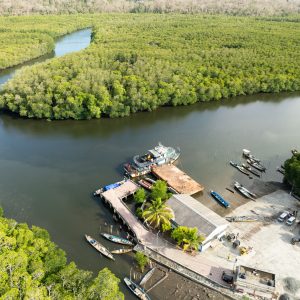
Nirwan said one of the most significant issues is land-use conversion. Many mangrove areas have been transformed into aquaculture ponds (linked to 44% of mangrove deforestation), plantations, settlements, industrial zones, and infrastructure developments. In several coastal regions, mangrove conversion for aquaculture has occurred for decades and remains one of the primary causes of mangrove loss. As a result of these pressures, Indonesia has lost more than 50% (source: FAO) of its mangrove cover over the past three decades, making it one of the countries with the highest rates of mangrove degradation in the world. This isn’t just about land; it’s about the 60% of Indonesia’s population whose lives and livelihoods are intertwined with these coastal forests.
Economic pressures often drive local communities to engage in unsustainable practices, such as converting mangrove forests into shrimp ponds, which in turn accelerates coastal erosion and increases their vulnerability to flooding. Others cut down mangroves to produce charcoal and sell it for a relatively good price.
“These pressures are not merely statistics; they translate into real challenges for local communities. People cut down mangrove forests without fully realizing the consequences that may one day arrive at their own doorstep,” said Nirwan.
Mangrove ecosystems also face challenges arising from limited public awareness of the importance of mangrove functions and economic dependence on extractive activities. When communities do not fully recognize the long-term benefits of mangrove conservation, pressure on these ecosystems tends to persist.
For this reason, YKAN emphasizes the importance of involving local communities in mangrove management and restoration efforts to foster a sense of ownership and ensure the sustainability of conservation initiatives.
In addition, governance and land status issues present further challenges. Some mangrove areas lie outside protected zones or are classified as production forests, making them more vulnerable to land conversion. At the same time, increasing climate change impacts, such as sea-level rise, coastal erosion, and tidal flooding, place additional stress on already degraded mangrove ecosystems. Therefore, YKAN promotes an integrated, science-based approach to mangrove management that actively involves government agencies, local communities, and the private sector to ensure the long-term protection and sustainability of mangrove ecosystems.
The most critical action needed to protect and restore mangrove forests while supporting local livelihoods is the implementation of a community-based approach, in which local communities become the primary actors in mangrove protection, management, and restoration. YKAN emphasizes that communities should be involved from the very beginning, including identifying problems, developing management plans, conducting patrols and monitoring activities, and participating in decision-making processes related to mangrove management. This approach is known as Community-Based Ecological Mangrove Restoration (CBEMR) and has proven to be more sustainable than mangrove planting alone.
In addition, YKAN believes that protecting existing healthy mangrove forests should be the top priority, as damaged mangroves require a very long time to recover their ecological functions and carbon storage capacity. Therefore, conservation efforts include protecting critical areas, supporting community patrols, strengthening village institutions, and providing legal access through social forestry schemes.


Read also