
Türkiye prepares to lead Turkic states amid regional tensions
As Türkiye prepares to take over leadership of Turkic States, tensions with Azerbaijan, competing Russian and Chinese interests, and new Eurasian trade routes expose limits of shared identity
© Anadolu Agency
By Iftikhar Gilani
ANKARA, Türkiye (MNTV) — The Turkic world stretches from the shores of the Mediterranean to the mountains bordering India and China. Its peoples share centuries of history, related languages, and cultural traditions. Yet only a handful live in independent Turkic-majority states. Millions of others remain within the borders of Russia and China.
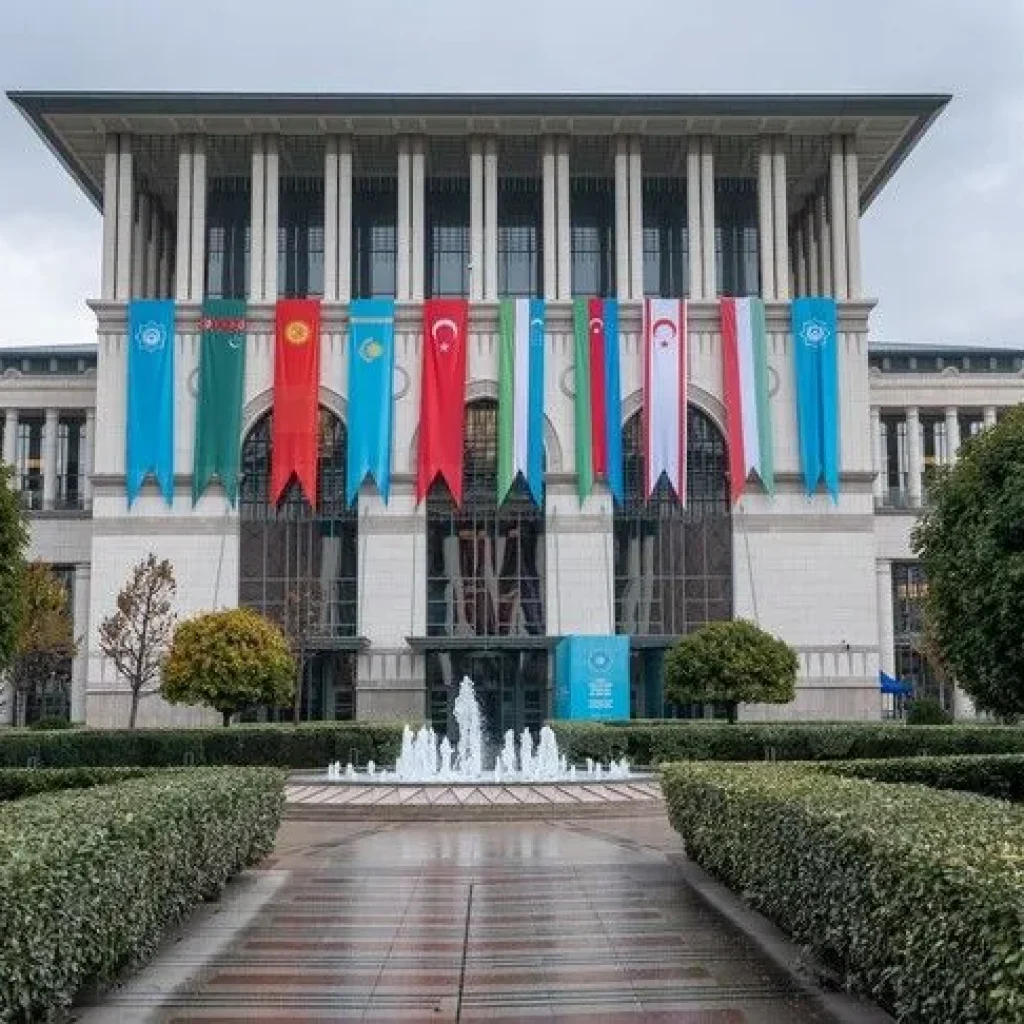
Bringing this vast and politically fragmented world closer together is the ambition behind the Organization of Turkic States (OTS), whose leaders gather in Ankara on Friday for their 13th summit.
Turkish Foreign Minister Hakan Fidan hosted his counterparts on Thursday to prepare the agenda for the leaders’ meeting. Azerbaijan’s Foreign Minister Jeyhun Bayramov attended, providing an important indication that recent disagreements between Ankara and Baku have not disrupted their institutional cooperation.
The meeting also brought together foreign ministers from Kazakhstan, Kyrgyzstan, and Uzbekistan, alongside representatives of observer states.
Friday’s summit, hosted by President Recep Tayyip Erdoğan, carries the theme Turkic Century: Unity in Language, Thought and Deed. Leaders are expected to adopt the Ankara Declaration, review cooperation in trade, transport, energy, and security, and consider the appointment of a new secretary-general.
Yet the more consequential question is whether the organization can translate its declarations of brotherhood into a common strategy without antagonizing Russia, China, and Iran, or allowing differences among its own members to undermine cooperation.
Azerbaijan’s participation has attracted particular attention because of recent friction between Ankara and Baku, two countries whose relationship is traditionally described as that of one nation, two states.
The disagreements have emerged partly over Azerbaijan’s restrictions on headscarves in schools. Azerbaijani authorities, fiercely protective of their political system, have rejected what they regard as interference in domestic affairs.
Baku also recently hosted Indian External Affairs Minister S. Jaishankar, demonstrating its willingness to pursue relations independently of Türkiye’s regional preferences.
For years, the close cooperation among Türkiye, Azerbaijan, and Pakistan had encouraged the impression of a strategic triangle. Their joint military exercises and diplomatic coordination, particularly over Kashmir and the South Caucasus, reinforced that perception.
But Azerbaijan’s engagement with India shows that Baku does not regard this partnership as an exclusive diplomatic commitment.
Türkiye has played down the disagreements, emphasizing the durability of its relationship with Azerbaijan. Bayramov’s presence in Ankara suggests both governments remain committed to cooperation despite their differences.
The episode nevertheless illustrates a wider challenge confronting the OTS. Common language and historical identity can encourage solidarity, but they cannot eliminate differences in domestic politics or foreign policy.
Vast world without political home
The expression Turkic world describes a geographical and cultural space far larger than the five countries belonging to the OTS.
It stretches from Türkiye and Azerbaijan across the Caspian Sea to Kazakhstan, Kyrgyzstan, and Uzbekistan, then farther east into territories now governed by Russia and China.
Historically, its trade routes and cultural connections extended through the Pamir Mountains and the old Silk Road networks to Ladakh in erstwhile Jammu and Kashmir, on the northern edge of the Indian subcontinent.
The organization has some parallels with the Arab League. Both seek to build cooperation among countries connected by language, culture, and history.
But there is an important difference.
Most Arab-majority countries are independent states, although Palestine remains under Israeli occupation. Across the Turkic world, by contrast, numerous historic Turkic homelands lie within the internationally recognized territories of Russia and China.
Within Russia, Turkic-speaking communities are concentrated in Tatarstan, Bashkortostan, Chuvashia, Sakha, or Yakutia, Tuva, Khakassia, and the North Caucasus. Dagestan, although predominantly home to non-Turkic ethnic groups, also has important Turkic communities, including Kumyks and Nogais.
Farther east, China’s Xinjiang, historically known to many Turkic communities as Eastern Turkistan, is home to Uyghurs, Kazakhs, Kyrgyz, and other Turkic-speaking peoples.
These populations have distinct political experiences and varying degrees of cultural autonomy. Their incorporation into Russia and China cannot simply be equated with the legal status of Palestine under international law.
Nevertheless, their existence demonstrates why the Turkic world cannot be understood merely through the borders of its independent states.
The OTS itself consists of Türkiye, Azerbaijan, Kazakhstan, Kyrgyzstan, and Uzbekistan. Turkmenistan participates as an observer, reflecting its longstanding policy of neutrality. Hungary, the Turkish Republic of Northern Cyprus, and the Economic Cooperation Organization also hold observer status.
Established in 2009 as the Turkic Council, the organization adopted its present name in 2021. Its ambition has gradually expanded beyond cultural exchanges to encompass investment, transport, digital connectivity, and increasingly, security cooperation.
Russia’s Turkic republics
Russia presents an unusual dimension to the project of Turkic unity.
Although Moscow has historically resisted movements that could encourage separatism within its borders, it has allowed Türkiye considerable cultural, educational, and economic engagement with its Muslim and Turkic communities.
Tatarstan, whose capital, Kazan, has long been a center of Islamic scholarship and Turkic culture, provides an important example.
Kazan hosts the annual Russia-Islamic World: KazanForum, which brings together businesses, government representatives, and institutions from Muslim-majority countries, including Türkiye. The event reflects Moscow’s efforts to cultivate economic and diplomatic relationships with the Islamic world.
Türkiye’s Directorate of Religious Affairs, known as Diyanet, has also maintained religious and educational links with Muslim communities in parts of Russia, including cooperation involving religious education, mosque activities, and the training of religious personnel.
Such engagement has helped Ankara retain cultural influence without directly challenging Russian sovereignty.
The distinction is crucial. Russia is willing to accommodate Turkish cultural and commercial activity, but it has little reason to welcome a political movement seeking to unite its Turkic populations under Ankara’s leadership.
China presents an even more sensitive challenge.
Türkiye has historical and linguistic connections with the Uyghurs of Xinjiang. Yet Beijing rejects political movements advocating independence under the name Eastern Turkistan and, unlike Russia, does not allow any external engagement.
For Ankara, the challenge is to maintain its role as a cultural center of the Turkic world without turning the OTS into a platform that threatens the territorial interests of two powerful neighbors.
Trump corridor
Perhaps the most tangible expression of Turkic cooperation lies not in language or culture, but in railways, highways, pipelines, and ports.
The proposed Zangezur corridor, now linked to the American-backed Trump Route for International Peace and Prosperity (TRIPP), could transform the economic geography of the South Caucasus.
The route is intended to connect mainland Azerbaijan with its Nakhchivan exclave through southern Armenia, creating a new transport link toward Türkiye.
For the Turkic states, its significance extends well beyond Azerbaijan.
A functioning connection through Nakhchivan would strengthen the broader Middle Corridor, a network linking China and Central Asia to Europe through the Caspian Sea, Azerbaijan, Georgia, and Türkiye.
It would offer additional routes for goods, energy, and investment, reducing dependence on transport networks passing through Russia or Iran.
The corridor also brings Washington directly into a region where Moscow, Tehran, and Ankara have historically competed for influence.
Under the Armenia-U.S. framework, the project is intended to operate within Armenian sovereign territory. The proposed development company would initially have a 74 percent American stake and a 26 percent Armenian stake, with development rights envisaged for an initial 49 years.
The agreement explicitly recognizes Armenia’s sovereignty and jurisdiction, an important distinction from earlier proposals that raised concerns in Yerevan about an extraterritorial corridor.
For Iran, the project raises concerns about losing transit influence and potentially facing a stronger Turkish-Azerbaijani transport network along its northern frontier.
Russia, meanwhile, must contend with the prospect of new trade routes operating outside its traditional regional infrastructure.
For the OTS, the corridor offers an opportunity to turn the idea of Turkic connectivity into a practical economic reality. Its success, however, will depend on implementation, financing, and sustained cooperation with Armenia, which is not a member of the organization.
Security cooperation
The Ankara summit also comes as the OTS develops a more substantial security dimension.
In September, Azerbaijan hosted a meeting of the secretaries of national security councils from member states. President Ilham Aliyev has advocated stronger security cooperation and proposed joint military exercises.
Meetings involving interior ministers, prosecutors, and defense industry officials have further expanded the organization’s agenda beyond its original cultural and economic purposes.
But the OTS is not a military alliance comparable to NATO.
Türkiye belongs to NATO, while Kazakhstan and Kyrgyzstan remain members of the Russia-led Collective Security Treaty Organization. Central Asian governments also maintain security and economic cooperation with China through the Shanghai Cooperation Organization.
These overlapping commitments make a common defense arrangement difficult.
For Kazakhstan, Uzbekistan, and Kyrgyzstan, participation in the OTS offers another diplomatic and economic partnership rather than a replacement for their existing relationships.
Security cooperation is therefore more likely to concentrate on border management, organized crime, cybersecurity, infrastructure protection, and defense technology than on collective military commitments.
The immediate challenge for the Ankara summit is to produce practical results.
The organization has already established institutions covering culture, parliamentary cooperation, investment, and trade. Its Turkic World Vision 2040 envisages closer integration across a broad range of economic and political activities.
But common declarations alone will not move cargo across borders or reduce the cost of transporting goods from Central Asia to Europe.
That will require harmonized customs procedures, more efficient Caspian ports, improved rail connections, digital documentation, and coordinated investment.
It will also require political restraint.
Azerbaijan will continue pursuing relationships with countries such as India and Israel. Türkiye will maintain its own regional priorities. Central Asian governments will seek to preserve their independence while cooperating with Russia, China, Europe, and the United States.
These differences do not necessarily weaken the OTS. They may instead determine the kind of organization it can realistically become.
As Türkiye assumes the chairmanship, Ankara faces a choice between pursuing an ambitious political vision of Turkic unity and concentrating on the practical interests that its members can share.
The meeting between Fidan and Bayramov on Thursday demonstrated that diplomatic cooperation can survive political disagreements. Whether that cooperation can produce lasting economic and institutional gains will be the larger test.
For a region stretching across the heart of Eurasia, the most enduring bonds may ultimately be built not through declarations of common ancestry, but through the roads, railways, energy networks, and commercial relationships connecting its peoples.
Related posts

Read also


