Turkic states sign Ankara Declaration, Türkiye takes helm
Leaders of the Organization of Turkic States backed closer unity, Middle Corridor trade and more support for Gaza as Türkiye assumed group's rotating chairmanship
© AA
By MNTV Staff
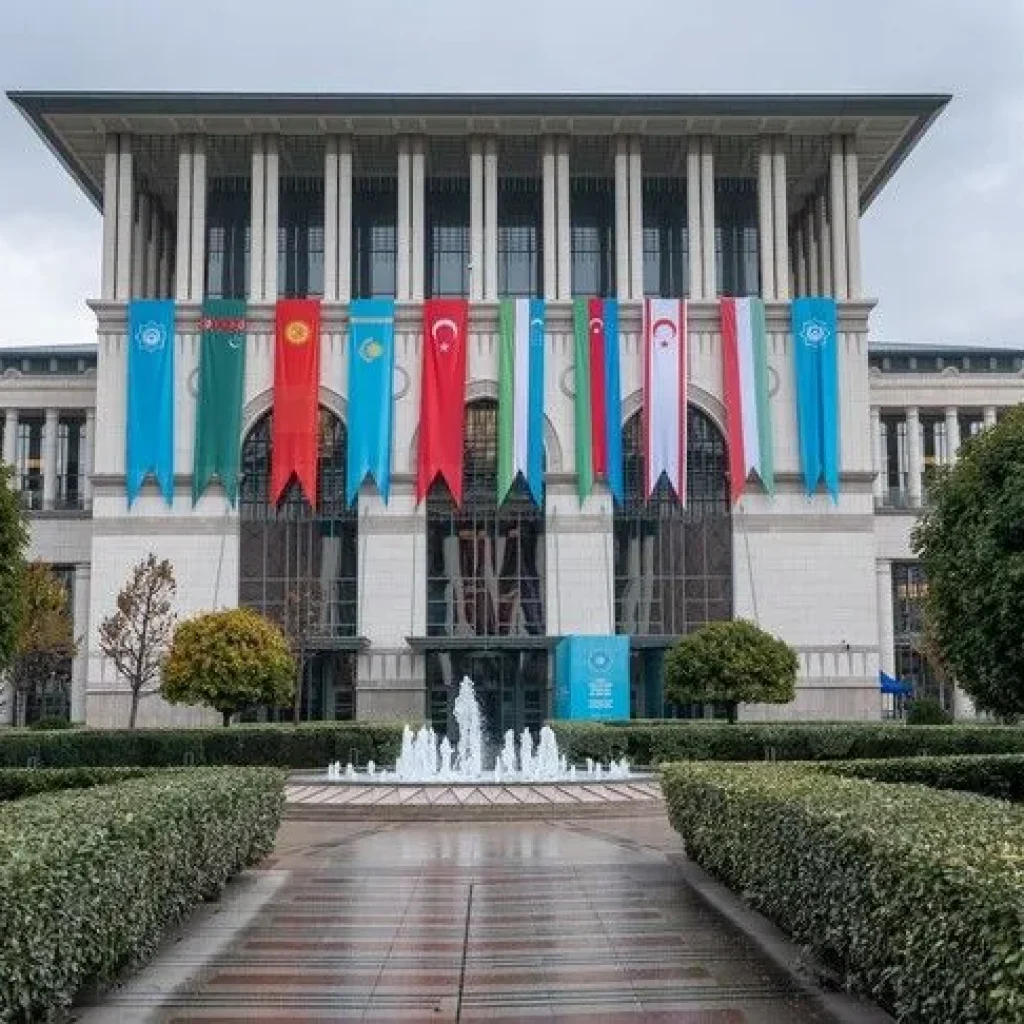
ANKARA (MNTV) – Leaders of the Organization of Turkic States (OTS) signed a joint declaration in Ankara on Friday at the close of their 13th heads-of-state summit, pledging deeper political, economic and cultural integration as Türkiye took over the bloc’s rotating chairmanship.
Hosted by President Recep Tayyip Erdogan under the theme “Turkic Century: Unity in Language, Thought and Deed,” the two-day gathering brought together the leaders of a bloc that links Türkiye with the Turkic-majority states of Central Asia and the South Caucasus.
Kazakh President Kassym-Jomart Tokayev, Uzbek President Shavkat Mirziyoyev and Kyrgyz President Sadyr Japarov attended, while Azerbaijan was represented by Foreign Minister Jeyhun Bayramov. Turkmen President Serdar Berdimuhamedov and Turkish Republic of Northern Cyprus (TRNC) President Tufan Erhurman joined as observers, alongside OTS Secretary-General Kubanychbek Omuraliev.
The Ankara Declaration was signed after addresses by Erdogan and the visiting leaders.
Türkiye assumed the chairmanship from Azerbaijan and is expected to steer the bloc’s agenda over the coming year, building on the long-term “Turkic World Vision 2040” framework the members adopted to guide integration.
‘Century of the Turkic World’
In his address, Erdogan framed closer cooperation as both a historic calling and a practical imperative.
Solidarity among Turkic states, he said, “has become a strategic necessity,” adding that “there is no room for division or discord in the Turkic world.” He said a family photograph of the leaders “symbolizes both our loyalty to our past” and their “determination to build our common future together.”
“I sincerely believe that the 21st century will be the ‘Century of the Turkic World,'” Erdogan said.
He pointed to the bloc’s geography as a bridge between Asia and Europe, describing the Trans-Caspian East-West “Middle Corridor” — a trade and transport route that runs from China through Central Asia and the Caspian Sea to Türkiye and on to European markets — as a major opportunity.
“The Turkic geography has the potential to become one of the major hubs of global transportation,” he said.
The corridor has drawn growing attention as shippers seek alternatives to routes through Russia.
Gaza, Cyprus and regional concerns
Erdogan used the summit to press fellow members on Palestine, urging the Turkic states to “do more” toward a just solution, including humanitarian aid and the reconstruction of Gaza after Israel’s devastating war on the territory.
The appeal reflects a theme Erdogan has pushed in multiple international forums, and one that resonates across the bloc’s publics.
He also reaffirmed support for the Turkish Cypriots, pledging to expand the opportunities created by the TRNC’s observer status in the organization.
The TRNC, in the north of the divided island of Cyprus, is recognized only by Türkiye.
Erdogan separately expressed hope that renewed tensions involving Iran would be resolved through diplomacy.
Trade, technology and common market
Beyond declarations of unity, the summit advanced a practical agenda of economic and technological cooperation.
Türkiye’s trade with the bloc’s four other full members reached about $17 billion in 2024, and leaders discussed measures to ease customs and logistics along shared corridors.
Ahead of the summit, the Turkish Union of Chambers and Commodity Exchanges hosted a Turkic World Business and Investment Forum focused on the Middle Corridor and border logistics.
Digital and space cooperation featured prominently.
Türkiye recently became the third member, after Azerbaijan and Uzbekistan, to ratify a digital economy partnership agreement meant to ease e-commerce and cross-border data flows, and members have discussed a joint digital agriculture platform and a shared CubeSat satellite project.
In a nod to cultural integration, officials said organizers planned to treat players from member states as domestic rather than foreign in one another’s football leagues.
Bloc on rise
The OTS traces its roots to the Turkic Council, founded in 2009 to deepen ties among Turkic-speaking states, and was renamed the Organization of Turkic States at a 2021 summit in Istanbul.
Its full members are Türkiye, Azerbaijan, Kazakhstan, Uzbekistan and Kyrgyzstan, with Turkmenistan, Hungary, the TRNC and the Economic Cooperation Organization holding observer status.
Analysts say the bloc’s significance has grown as Central Asian states diversify their partnerships and global shippers look to the Middle Corridor, though they caution that turning summit pledges into concrete timelines remains the test of whether the “unity in deed” invoked in Ankara will be realized.
Related posts

Read also