Spain is not leading a European turn on Israel — but it’s making continued inaction harder to disguise, analyst argues
Spain has assembled the most comprehensive set of measures against Israel of any major EU member state since the genocide in Gaza began
© AA
MADRID (MNTV) — Spain has assembled the most comprehensive set of measures against Israel of any major EU member state since the genocide in Gaza began — from recognising Palestinian statehood and intervening in South Africa’s ICJ genocide case, to imposing an arms embargo, banning settlement imports, restricting military transit through Spanish ports, and refusing the United States access to the jointly operated bases at Rota and Morón for strikes on Iran.
But has any of it actually moved Europe? Writing for the New Arab, Dr Luciano Zaccara — a principal researcher at New Ground Research in Qatar and visiting associate professor at Georgetown University Qatar — argues that the honest answer is: not yet, and probably not soon. What Spain has done, he contends, is something different and potentially more durable: it has widened the boundaries of what can be discussed.
The logic behind Madrid’s approach
Zaccara frames Spain’s position not as radical but as restorative — an attempt to hold Europe to the rules it already claims to uphold. Madrid’s central argument, he writes, is that the EU cannot treat international law as binding when Russia violates it in Ukraine but negotiable when Israel violates it in Palestine. That framing has given Spain’s measures a coherence that goes beyond individual policy decisions.
The same principle, he argues, explains why Sánchez refused base access for US strikes on Iran. This was not an anti-American gesture or a break with NATO but an assertion that alliance membership does not require automatic complicity in wars a government considers illegitimate.
The Pentagon’s response — floating punitive measures against Spain — and Trump’s subsequent suggestion that he might withdraw US troops from both Spain and Italy revealed how narrow the space for European autonomy remains within the Atlantic alliance.
Why Europe hasn’t followed
The structural obstacle, Zaccara argues, is that Europe does not function as a unified actor on Israel. It operates as a patchwork of historical debts, strategic dependencies, domestic pressures, and political taboos. Germany’s relationship with Israel is shaped by the Holocaust; Italy’s by its Atlanticist instincts; Eastern Europe’s by security calculations and alignment with Washington. The result is paralysis dressed up as prudence.
Spain can build pressure and convene like-minded states — Ireland, Slovenia, Belgium, and potentially Norway outside the EU framework — but it cannot manufacture the consensus needed to force Germany, Italy, or the European Commission to fundamentally redefine the EU-Israel relationship.
When Spain, Ireland, and Slovenia pushed again in April 2026 to suspend parts of the EU-Israel Association Agreement, the initiative failed for lack of support.
Cracks in consensus
Yet Zaccara identifies signs that the political terrain is shifting at the margins. Viktor Orbán’s defeat in Hungary removed one of Israel’s most reliable shields within EU decision-making and weakened the broader illiberal axis that had aligned itself with Netanyahu and Trump.
Italy offers a more ambiguous signal: Giorgia Meloni, among Europe’s most Zionist right-wing leaders, nonetheless suspended the automatic renewal of Italy’s defence cooperation agreement with Israel in April.
This does not mean Rome has joined Madrid’s line, Zaccara cautions, but it suggests that unconditional alignment with Israel is becoming more politically expensive even for parts of the European right.
Precedent, not revolution
Zaccara’s core argument is that Spain’s real impact lies not in producing an immediate European rupture with Israel but in normalising a set of policy options that were previously dismissed as marginal.
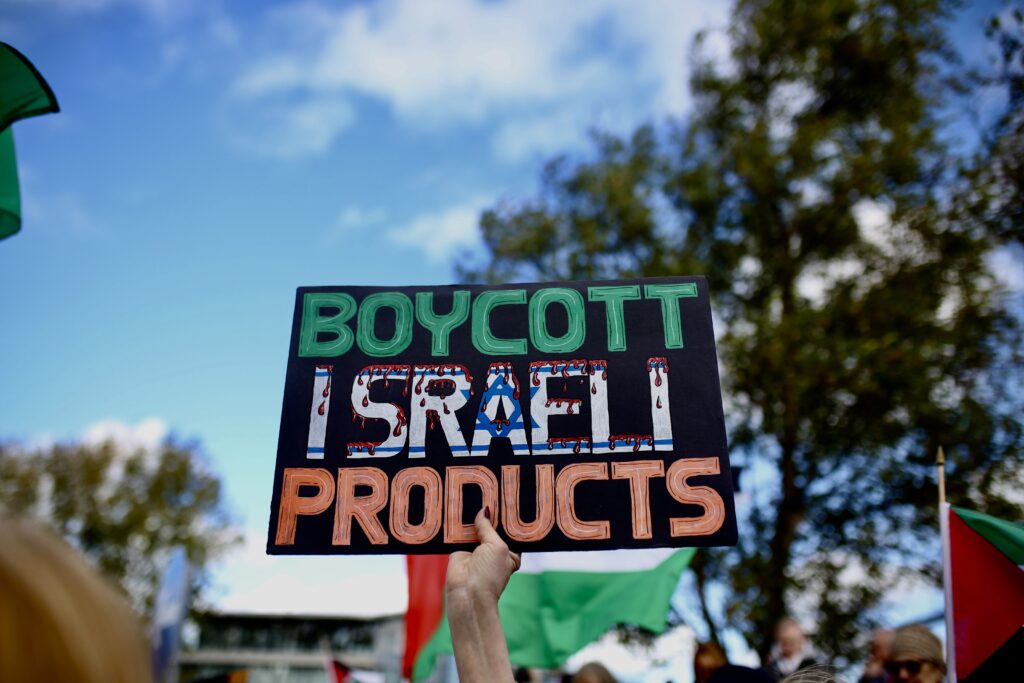
Before Gaza, he writes, suspending the EU-Israel trade agreement, banning settlement goods, restricting military transit, refusing base access for regional wars, or joining legal proceedings against Israel were treated as fringe demands.
Spain has helped move them into the mainstream of European debate, giving other governments language, legal arguments, and political cover.
He acknowledges that Madrid’s position is not without contradictions. Spain remains embedded in NATO, in a European defence ecosystem that includes Israeli technology, and in institutional relationships that complicate any claim of a clean break.
But that, he argues, is precisely what makes the position significant: a Western, EU, NATO member state is using the language of international law against the permissive consensus that has long shielded Israel from consequences.
For Palestinians in Gaza, Zaccara concludes, none of this is enough. But politically, it represents a step forward — one that may not transform European policy today but makes it progressively harder for European governments to pretend that doing nothing is a neutral choice.

Read also