From headscarf ban to NATO host: Emine Erdoğan’s journey
Twenty-two years after headscarf exclusion, Türkiye's first lady became the face of NATO's Ankara summit, reflecting changing approach to faith, identity, protocol
© File Photo
By Iftikhar Gilani
ANKARA (MNTV) — Twenty-two years after being excluded from official NATO events because she wore a headscarf, Türkiye’s First Lady Emine Erdoğan stood at the center of the recently concluded NATO Summit in Ankara.
She was seen welcoming world leaders’ spouses and representing the host nation at one of the Alliance’s most important gatherings.
Throughout the summit, she personally received the spouses of presidents, prime ministers and senior NATO leaders and also chaired a parallel summit at historic Çankaya Presidential Mansion to discuss “Children, Technology and Security.”
The meeting itself focused on digital safety for children, but for many observers it was the symbolism surrounding its host that attracted equal attention.
The images from Ankara stood in sharp contrast to those from the 2004 NATO Summit in Istanbul.
Back then, Recep Tayyip Erdoğan was serving as prime minister while Ahmet Necdet Sezer, a staunch defender of Türkiye’s strict secular establishment, was president. State protocol at the time effectively excluded women wearing the Islamic headscarf from many official functions.
When President Sezer hosted NATO leaders and their spouses at the historic Dolmabahçe Palace, Prime Minister Erdoğan received an invitation without his wife.
Rather than provoke a public confrontation over protocol, he attended the official dinner alone. Emine Erdoğan remained absent from the reception, official photographs, and other summit events because she wore a headscarf.
The incident became one of the defining symbols of Türkiye’s decades-long restrictions on religious dress in public institutions. For years, women wearing headscarves faced barriers in universities, parliament, government offices and official state ceremonies under laws intended to preserve the country’s strict interpretation of secularism.
This year, however, the picture could hardly have been more different.
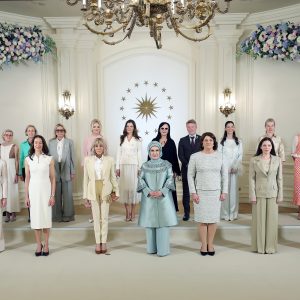
Instead of being kept away from protocol, Emine Erdoğan became one of the principal hosts of the summit, welcoming international guests with confidence while representing Türkiye before the world’s most powerful military alliance.
The transformation was particularly striking for those who witnessed both summits.
Beyond Protocol
Zeeshan Malik, a lecturer at Ankara University and an expert on international strategic affairs, attended the 2004 NATO Summit in Istanbul as a student. Having also observed this year’s summit in Ankara, he believes the differences extend far beyond protocol.
“The strategic environment, the political atmosphere and Türkiye’s self-confidence have all changed dramatically over the past two decades,” Malik told MNTV.
He recalled that during the Istanbul summit, Emine Erdoğan was instructed to stay away from official ceremonies, receptions, photographs and protocol events solely because she wore the traditional Islamic headscarf.
“The understanding at the time was that some Western leaders and even their spouses would be uncomfortable appearing alongside a headscarf-wearing woman,” Malik said.
“Under Türkiye’s rigid secular state system and military-backed protocol, the headscarf was regarded as an unacceptable symbol in official state functions.”
According to Malik, this year’s summit presented an entirely different image.
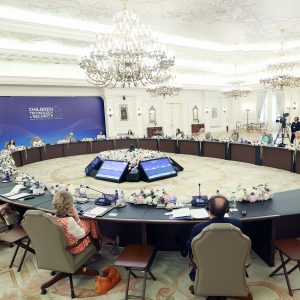
“History had changed,” he said. “Emine Erdoğan, wearing her signature light green headscarf, was present at virtually every major protocol event.
She personally welcomed presidents, prime ministers and their spouses at the Presidential Mansion and became one of the principal faces of the host country.”
He noted that beyond welcoming guests, Emine Erdoğan chaired the spouses’ meeting at Çankaya Mansion, although he believes the symbolism of her role outweighed the agenda itself.
“This was not simply about one woman participating in protocol,” Malik said.
“It reflected Türkiye’s confidence in presenting its Islamic and Eastern cultural identity without apology. Twenty-two years ago, the country was in a defensive position, eager to gain acceptance from the West and advance its European Union aspirations.
Within NATO, it largely saw itself as a compliant host. Today’s Türkiye engages with its allies with much greater confidence in its own identity.”
Malik believes the contrast between the two summits illustrates how dramatically Türkiye’s domestic political landscape has evolved since the early 2000s.
Turkish journalist and commentator Betül Tılmaç argues that the significance of the moment extends beyond the Erdoğan family.
“Twenty-two years ago, Emine Erdoğan was not invited to the official dinner because of her headscarf. This time, she hosted 32 heads of state and government along with their spouses,” Tılmaç wrote, describing the contrast as one of the defining images of the Ankara summit.
According to Tılmaç, diplomatic protocol often conveys political realities more clearly than official communiqués.
“Who is admitted to the table and who is left outside often carries more political meaning than official statements,” she observed, arguing that the 2004 protocol dispute reflected a broader debate that many democratic societies continue to face over the visibility of religion in public life.
She points to France as an example. While Türkiye gradually lifted restrictions on headscarves in universities, parliament and public institutions, France introduced legislation banning conspicuous religious symbols in public schools in 2004, prohibited face-covering garments in public spaces in 2010 and later banned the abaya in schools.
Headscarves also remained prohibited for members of the French Olympic delegation at the Paris 2024 Games.
Tılmaç argues that Türkiye chose a different path.
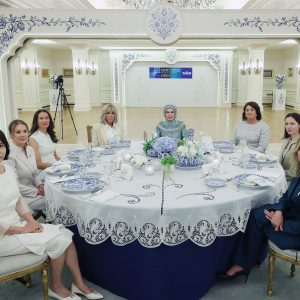
Rather than narrowing official protocol, she says, Türkiye expanded it to include women who had long been excluded because of their religious dress.
“Lifting the restriction neither weakened public order nor undermined secularism,” she wrote. “On the contrary, it allowed the state to represent every segment of society while hosting international summits with greater confidence.”
Whether viewed through the lens of politics, diplomacy or social change, the images from Ankara carried a powerful historical message.
The woman who remained outside the official photographs at the 2004 NATO Summit in Istanbul because of her headscarf was, twenty-two years later, greeting world leaders, hosting international guests and representing Türkiye before the Alliance.
For many in Türkiye, Emine Erdoğan’s journey mirrors the country’s own transformation, from a state where the headscarf was treated as incompatible with official protocol to one where it is no longer seen as a barrier to representing the nation on the world’s biggest diplomatic stage.
Related posts


Read also