The eleven of independence: The team that played for a country that did not yet exist
Banned by FIFA, hunted as deserters, cheered from Tunis to Hanoi — how eleven footballers gave up the World Cup to play for an Algeria that didn't yet exist
© Wikimedia Commons
By MNTV Staff Writer
As the 2026 World Cup unfolds across North America and Algeria’s Fennec Foxes chase glory on the sport’s biggest stage, it’s worth remembering the eleven men who once played for an Algeria that didn’t yet exist.
On a Monday in mid-April 1958, a car carrying four young men rolled up to the French-Swiss border. The guards leaned in — and asked for autographs.
The officers waved the vehicle through without a single awkward question, never realizing that the men signing their names — among them Rachid Mekhloufi, the star of French champions Saint-Étienne — had just passed the point of no return.
They were not on their way to a match. They were deserting France to play for a country that did not yet exist.
Within days, French newspapers were carrying the same astonishing story. Some of the finest footballers in the country, nearly all of them Algerian, had simply disappeared.
The sports daily L’Équipe reported that nine of the dozens of Algerians playing professionally in France had vanished, observing wryly that the French national team remained intact — only the meaning of the word “France” had narrowed.
The New York Times framed it as a defection of star players to the rebel cause. TIME, as recounted by researcher Jalal Abukhater, called it simply “The Disappearing Act.”
Men who walked away
To grasp the scale of the sacrifice, consider who these men were. Mekhloufi had scored a torrent of goals to carry Saint-Étienne to their first French championship and stood on the threshold of superstardom; World Soccer notes he was in the forty-man provisional pool for France’s 1958 World Cup squad.
Mustapha Zitouni, the elegant defensive cornerstone at Monaco, was reportedly being courted by Real Madrid after a dazzling display against Spain.
Both were expected to line up for Les Bleus in Sweden that summer.
Instead, two months before the tournament, they slipped out of France with around eight other Algerian professionals and made for Tunis, home of the Algerian provisional government.
They were not naïve about the cost.
Several were doing military service and would be branded deserters; Mekhloufi, a reservist, was later sentenced in absentia to ten years in prison, a punishment confirmed across multiple accounts.
Many left behind wives, children, friends and the comfortable salaries of a footballer admired in the cities he represented.
Zitouni, who had asked whether he might at least play the World Cup first, ultimately reasoned, as he told the story later, that the cause was simply “bigger than us.” Mekhloufi put it more plainly still: they wanted, he said, to play matches for Algeria.

Mind behind the team
The idea belonged to Mohamed Boumezrag, a former professional in the French leagues who had been struck by the political power of sport while attending a youth festival in Moscow.
He brought the plan to the leadership of the FLN — the Front de Libération Nationale, the movement waging Algeria’s armed struggle for independence from France — where it found an enthusiastic champion in Ahmed Ben Bella — himself once a footballer in France, later the FLN’s leader and independent Algeria’s first president.
Football, Ben Bella understood, could show the world that Algeria was ready to stand on its own in every arena of life. Boumezrag began quietly recruiting, moving among the scattered Algerian players of the French first division.
By the players’ own account, the calculation was clear: if Zitouni, the cornerstone of the French defence, agreed to go, the others would follow.
The escape itself was a tense, clandestine operation, with players filtering out through Switzerland and Italy.
Not everyone made it. Hassen Chabri was arrested at a border on suspicion of smuggling arms; another would-be defector, Mohamed Maouche, was held up so long that he turned back rather than risk capture.
But the core of a team assembled in Tunis — and the FLN, which had not even initiated the scheme, suddenly realized it was holding a propaganda triumph.
The provisional government’s leadership would later claim the team had advanced the cause of Algerian independence by a decade.
Banned, but unbowed
France moved fast to strangle the project, persuading FIFA to refuse the team any recognition and to threaten sanctions — even World Cup expulsion — against any nation that played them.
It did not work. Undeterred, the Équipe FLN, nicknamed Le Onze de l’Indépendance, “The Eleven of Independence,” set out on a tour of the only world that would have them: the newly independent and the not-yet-free.
One of their first outings was a North African tournament the FLN organized themselves and named for Djamila Bouhired, a young activist tortured by French authorities.
Morocco and Tunisia, both freshly independent and applying to join FIFA, played anyway as a gesture of solidarity — and saw their FIFA membership delayed into 1960 as a result.

From there the team ranged across the Middle East, Eastern Europe and Asia, reaching as far as China and North Vietnam, where, by one frequently told story, General Giáp joked about having kicked French forces all the way to Algeria.
Sources differ on the exact tally — estimates run from around seventy matches to the ninety-one cited by Wikipedia and World Soccer, of which the team won well over half.
But the numbers were almost beside the point.
The real victory came before kickoff: every host had to agree to fly the Algerian flag and play the anthem, Kassaman.
For a people the colonial power insisted did not constitute a nation, those few minutes of green-white-and-red and a sung anthem were among the most powerful acts of recognition imaginable — a country willed into being on football pitches from Tunis to Hanoi.
Many of those matches were played against fellow Muslim and Arab nations, knitting Algeria’s struggle into a wider current of post-colonial solidarity across the Islamic world.
What football remembered
The war that framed all this was among the bloodiest of the decolonization era; estimates of the dead range from several hundred thousand to well over a million, depending on the source.
When it finally ended and Algeria gained independence on 5 July 1962, the Équipe FLN had served its purpose.
The team was disbanded in June 1962, handing its place to the official Algeria national side that would join FIFA soon after. Some players retired; some stayed home; some went back to France.
Mekhloufi was among those who returned, rejoining Saint-Étienne and inspiring the club to further titles. In a detail that captures the strange, knotted intimacy of the two nations,
These Football Times notes that he lifted the 1968 Coupe de France and received his medal from the hands of French President Charles de Gaulle — a decade after fleeing the country as a so-called deserter.
Reflecting on the journey years later, Mekhloufi told France 24 that the experience had transformed him from a young man who knew only football into someone who could speak with heads of state and revolutionaries: before it all, he said, “I was a donkey.”
There is a final symmetry that closes the circle.
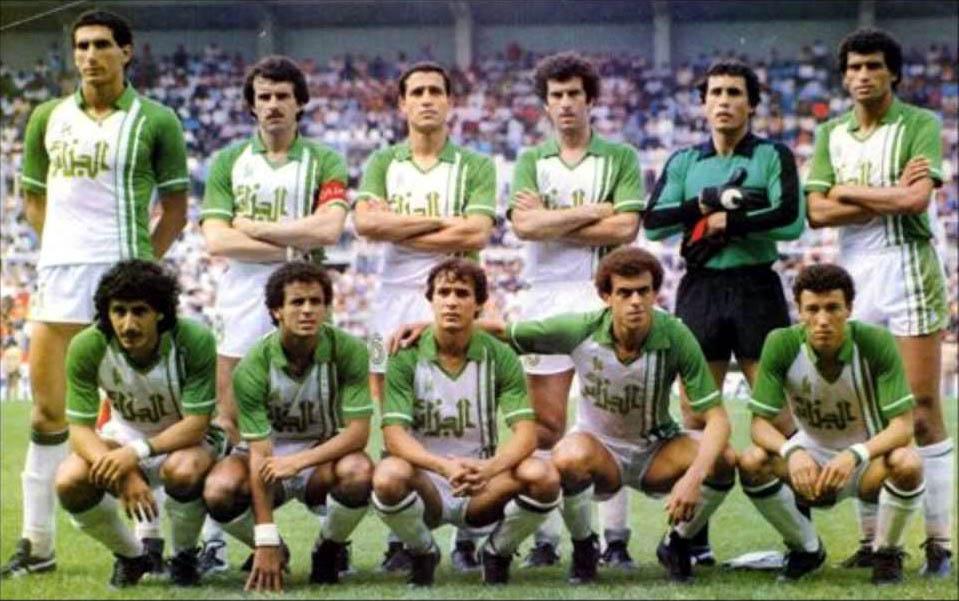
The same Mekhloufi who had forfeited one World Cup for an Algeria that did not exist lived to take the real nation to its first one: in 1982, alongside Mahieddine Khalef, he helped guide Les Verts to their debut at the World Cup in Spain, where Algeria stunned West Germany — the first African side ever to beat a European team at the tournament, as FIFA’s own records note.
The man who once played for a country that wasn’t there had helped carry the country that finally was onto the sport’s biggest stage.
That tangled inheritance never really ended. One in roughly every ten people in France has a direct family connection to Algeria, and the loyalties of footballers from Zinedine Zidane to Karim Benzema to Riyad Mahrez still trace back, however distantly, to the fault lines of that war.
Zidane himself has been photographed proudly holding an image of the FLN side — and now, at the 2026 World Cup, his son Luca lines up in Algeria’s green, having chosen the nation those eleven men dreamed into being.
More than sixty years on, the team that gave up a World Cup to play for a country that did not yet exist remains one of football’s most stirring proofs that the game has never been only a game.


Read also