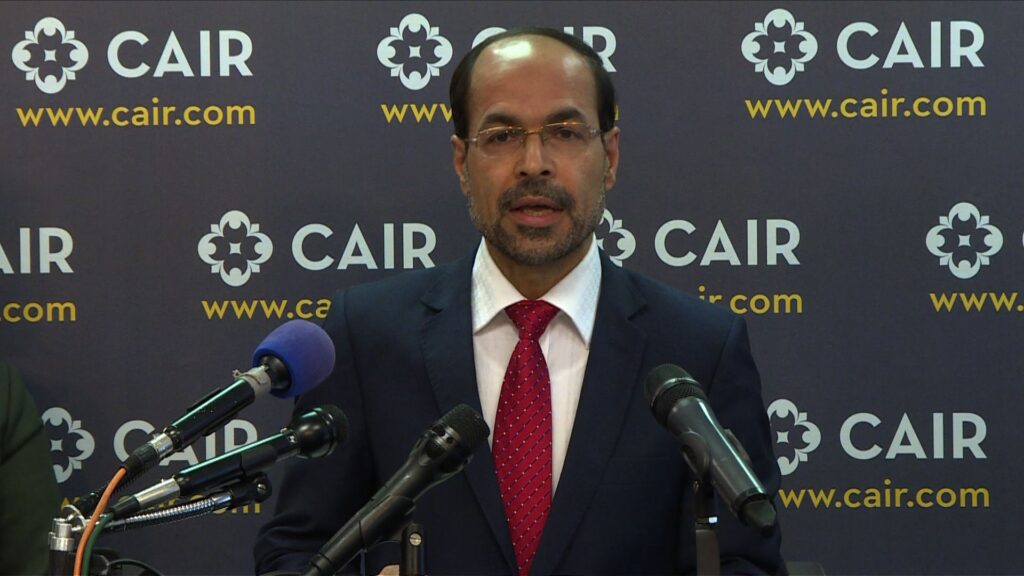
Who is Abdul El-Sayed, one step from becoming America’s first Muslim senator after beating $60m in pro-Israel spending?
Progressive doctor overcame the most expensive Senate primary in US history — much of it AIPAC-backed money aimed at stopping him — to win Democratic nomination
© Commons
DETROIT (MNTV) — Abdul El-Sayed, a progressive physician and former public health official who has described Israel’s assault on Gaza as a genocide, has won the Democratic nomination for the US Senate in Michigan — surviving one of the most expensive and bitterly contested primaries in American political history, and moving within a single election of becoming the first Muslim ever to serve in the United States Senate.
Major networks, beginning with NBC News, projected El-Sayed the winner on Wednesday, more than twelve hours after polls closed, in a race so close it was not called on election night.
With nearly all ballots counted, he led Congresswoman Haley Stevens by roughly a single percentage point.
He will now face former Republican congressman Mike Rogers in November in a contest widely regarded as one of a handful that could determine which party controls the Senate for the remainder of Donald Trump’s term.
Victory over record spending
The scale of the money spent trying to stop El-Sayed was extraordinary. The race drew more than $60 million in campaign spending — much of it from pro-Israel groups, led by the American Israel Public Affairs Committee (AIPAC), which poured over $30 million into backing Stevens.
By several accounts it was the most expensive Senate primary the country has ever seen.
Much of that outside money funded a wave of attack advertising.
Yet the strategy appears to have backfired. Voters interviewed by Bridge Michigan described the barrage of spending as a waste, and the executive director of the non-partisan Arab American Institute, Maya Berry, said Michiganders had simply refused to accept an advertising blitz that avoided policy and instead trained its fire on, in her words, an Arab American Muslim man named Abdul.
She called the outcome a major moment and said she was thrilled for the rest of the country to see that Michigan would not be swayed by it.
The result landed as a significant blow to AIPAC, which had made defeating El-Sayed a priority, and as a marker of shifting sentiment within the Democratic electorate over US policy toward Israel at a time when American public opinion has turned increasingly critical.
Establishment lines up — and loses
El-Sayed ran unambiguously from the left, and quickly consolidated progressive support.
He was endorsed by Vermont Senator Bernie Sanders, Congresswoman Alexandria Ocasio-Cortez, and Maryland Senator Chris Van Hollen, occupying the leftward lane in the primary much as he had in his 2018 run for governor.
The party establishment, meanwhile, coalesced around Stevens, who cast herself as the more electable, Michigan-focused candidate and accused El-Sayed of concentrating too heavily on national issues.
In the campaign’s final stretch, popular Governor Gretchen Whitmer — who had defeated El-Sayed in the 2018 gubernatorial primary — endorsed Stevens, a move widely read as a last-ditch effort to halt his momentum. It was not enough.
In a sign of the party’s instinct to close ranks for the general election, Stevens congratulated El-Sayed almost immediately after the race was called, praising him as a doctor, a community health official, a Rhodes Scholar, and a dedicated Michigander, and pledging her support against Rogers.
For his part, El-Sayed struck a unifying note, telling supporters that whatever divisions the primary had exposed were dwarfed by what Democrats shared — and that the priority now was ensuring Rogers never reached the Senate.
Who he is
Abdul El-Sayed, 41, is a physician and epidemiologist, the son of an Egyptian immigrant father, and was partly raised by a stepmother whose family has farmed in rural Michigan since the 1800s — a dual heritage he leans on frequently in describing the state.
He captained the lacrosse team at the University of Michigan and graduated Phi Beta Kappa — the prestigious academic honour society that admits only top-performing US university students — before winning a Rhodes Scholarship, earning a doctorate in public health at Oxford, and taking his medical degree at Columbia, where he taught epidemiology.
He built his public profile in government.
Appointed health director for the city of Detroit in 2015, he became the youngest public health official in a major American city, tasked with rebuilding a department that had been privatised during the city’s bankruptcy. He later led the health department of Wayne County, Michigan’s largest and most diverse, serving some 1.8 million residents.
He mounted a high-profile but unsuccessful bid for governor in 2018, losing the Democratic primary to Whitmer.
Politics of moment
El-Sayed’s candidacy has become, in the words of several observers, a microcosm of the widening rift inside the Democratic Party over Israel and Gaza. He has been outspoken in describing Israel’s actions as genocide and has built his economic argument around the idea that money spent on foreign conflicts should instead be invested at home — in healthcare, housing, and infrastructure.
In an interview with Muslim Girl before the vote, El-Sayed framed the two as inseparable, arguing that a country failing to provide healthcare at home while funding bombs abroad had its priorities backwards — and that ending what he called unnecessary wars and the subsidising of genocide would free resources for the things Americans need.
His opponent, Stevens, is staunchly pro-Israel; in 2024 she joined House Republicans in voting to bar the State Department from citing Gaza’s health-ministry death toll.
That contrast is precisely why the race drew such enormous outside spending, and why El-Sayed’s win is being read well beyond Michigan as a test of whether pro-Israel money can still reliably shape Democratic primaries.
The president himself responded to the result, making clear he viewed El-Sayed’s nomination as an opportunity for Republicans.
In characteristically incendiary terms, Trump called El-Sayed’s victory “great news” for his party and attacked the nominee in personal and inflammatory language — a preview of the tenor the general election is likely to take in a swing state Trump carried in 2024.
What comes next
The November contest against Rogers will be fought in a genuine battleground, for a seat being vacated by retiring Democratic Senator Gary Peters, and potentially for control of the chamber. If El-Sayed prevails, he will make history as the first Muslim United States senator — a milestone for a generation of American Muslim public servants who have increasingly moved from the margins toward the centre of the country’s civic life.
For now, El-Sayed’s message was brief and triumphant. “Michigan… We won,” he wrote online after the long hours of uncertainty. “I am so proud to be your Democratic nominee for US Senate. Let’s win in November.”



Read also