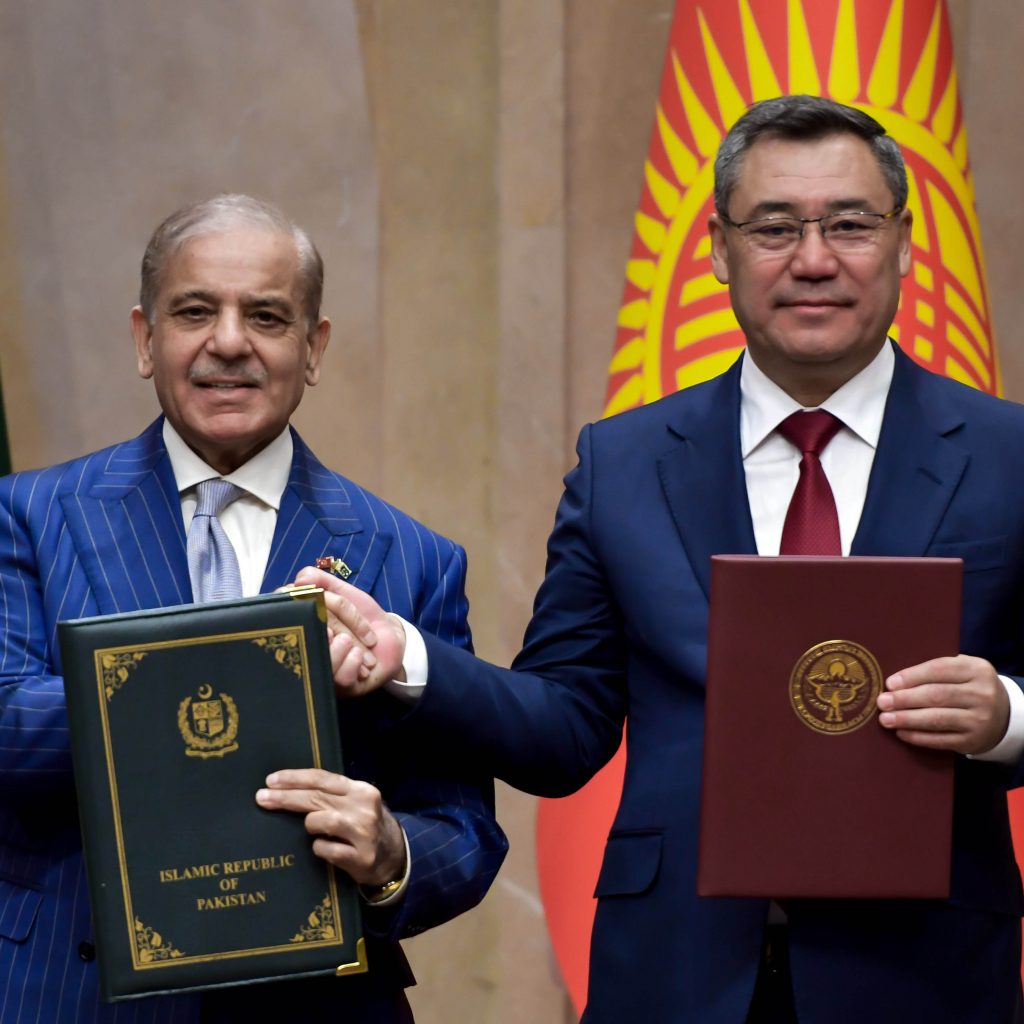
Trump convenes inaugural ‘Board of Peace’ meeting in Washington
United States President Donald Trump has officially convened inaugural meeting of his self-styled "Board of Peace"
© AA
WASHINGTON (MNTV) — United States President Donald Trump has officially convened the inaugural meeting of his self-styled “Board of Peace” at the United States Institute of Peace in Washington, DC, bringing together world leaders, diplomats, and power brokers in what the administration is billing as a historic new forum for global conflict resolution.
Established under Trump’s initiative, the body is an international forum designed to operate largely outside the traditional multilateral architecture — functioning as an alternative to institutions like the United Nations.
Its central mandate, at least for now, is to coordinate funding, troops, and strategies for the reconstruction and stabilisation of war-torn Gaza.
Trump’s team envisions it eventually tackling complex conflicts far beyond the Middle East.
Trump opens meeting
Opening the session, Trump wasted little time setting the tone.
Peace, he told the assembled leaders, is “an easy word to say but a hard world to produce.”
He went on to claim that his administration had already resolved eight wars in its first year alone, hinting that a ninth resolution was within reach — though he conceded it was proving “a tougher one.”
“The Board of Peace is one of the most important and consequential things I think I’ll ever be involved in,” Trump declared, speaking before a room he described as containing “the greatest world leaders” ever assembled under one roof.
He lavished praise on his inner circle, singling out US envoy Steve Witkoff, his son-in-law Jared Kushner, Secretary of State Marco Rubio, and Vice President JD Vance, calling them “the best team ever assembled.”
The situation in Gaza, Trump acknowledged, remains “very complex.”
Funding commitments, troop pledges
On the financial front, Trump announced that a coalition of nations — including Kazakhstan, Azerbaijan, Morocco, Bahrain, Qatar, Saudi Arabia, Uzbekistan, Kuwait, and the United Arab Emirates — have collectively contributed more than $7 billion toward what he described as a “relief package.”
The figure surpasses the $5 billion Trump had floated earlier in the week, though no further breakdown of those funds was provided.
The United States itself has pledged a $10 billion contribution to the board’s reconstruction efforts.
On the military side, Indonesia has preliminarily committed 1,000 troops to an international stabilisation force in Gaza.
Albania, Kosovo, and Kazakhstan have also pledged troops and police personnel, while Egypt and Jordan were praised for offering training and support for what Trump called “a very trustworthy Palestinian police force.”
However, independent experts have cautioned that a meaningful international deployment remains unlikely until Hamas disarmament talks produce a concrete agreement and Israeli ceasefire violations come to a definitive end.
Gaza backdrop: Genocide that has not ended
Trump’s optimistic framing stood in sharp contrast to the grim reality on the ground in Gaza.
Israel’s genocide, which the administration has described as winding down, has now claimed the lives of at least 72,069 Palestinians and wounded a further 171,728 since it began in October 2023 — figures that continue to climb.
Trump on Thursday declared that “the war in Gaza is over,” pointing to a ceasefire agreement that came into force in October.
Yet that ceasefire has been violated on a near-daily basis. More than 600 Palestinians have been killed since the agreement took effect, and a recent United Nations report has raised serious alarm, citing credible concerns over ethnic cleansing in both Gaza and the occupied West Bank, where Israeli forces and settlers have continued to carry out raids and land seizures.
Trump appeared to brush aside the ongoing bloodshed, characterising the continued violence as “little flames.”
Iran in crosshairs
Trump used the platform to deliver a pointed warning to Tehran.
“Now is the time for Iran to join us on a path that will complete what we’re doing,” he said, adding that if they chose not to, it would be “a very different path.”
“They cannot continue to threaten the stability of the entire region. They must make a deal,” he stressed. “Bad things will happen if it doesn’t.”
His remarks came as the US military has been quietly and significantly bolstering its presence in the Gulf, with reports from Israeli and regional media suggesting that a military confrontation with Iran may be considerably closer than Trump administration officials are publicly acknowledging.
Football, FIFA, and Nobel Prize
In what observers described as a characteristically Trump-style tangent, the president announced plans to construct football fields in Gaza and bring “the greatest stars” of world football to the territory.
FIFA president Gianni Infantino, present at the gathering, was thanked personally by Trump after the global football body awarded the president a peace prize.
“I got screwed by Norway,” Trump quipped, revisiting his well-documented frustration at being passed over for the 2025 Nobel Peace Prize.
“And they said, ‘Let’s give him a peace prize.’ Thank you, Gianni. Gianni is very smart.”
Vance and Rubio weigh in
Vice President JD Vance briefly took the floor, offering effusive praise for Trump’s approach to diplomacy.
“If you actually have a president of the United States and a team that’s committed to diplomacy, it can actually work,” he said, adding that the board’s deeper purpose was to “make the peace stick.”
His remarks, however, glossed over a sobering contradiction: both the Trump and Biden administrations have repeatedly exercised their veto power at the UN Security Council to block resolutions calling for an end to the genocide in Gaza — the very issue the Board of Peace now purports to help resolve.
Secretary of State Marco Rubio also weighed in, arguing that Gaza had presented “a very unique crisis” that existing international institutions had proven incapable of resolving.
He credited Trump with thinking “outside the box” and expressed hope that the board could eventually serve as a model for other intractable conflicts. “In Gaza,” Rubio acknowledged soberly, “we have a long ways to go.”
The board has not been without its critics from the outset.
Trump’s decision to extend invitations to both Netanyahu and Putin — leaders who are subjects of International Criminal Court arrest warrants for war crimes — has drawn sharp international condemnation.
Experts argue the move signals a troubling disregard for international humanitarian law and risks legitimising leaders accused of grave atrocities on one of the world’s most prominent diplomatic stages.
New world order — or just a new meeting room?
Closing out his remarks, Trump announced that the Board of Peace would additionally serve an oversight function over the United Nations, ensuring it “runs properly,” and could assist the UN “money-wise” to keep it “viable.”
He offered no further detail on the mechanics of that arrangement.
“The Board of Peace will be something the likes of which nobody has seen before,” he declared.
Whether that proves to be an ambitious new chapter in global diplomacy or a grandiose gathering with little follow-through remains to be seen.
What is not in dispute is that for the people of Gaza — still living under bombardment, displacement, and the threat of ethnic cleansing — the stakes could not be higher.
Read also