Profile: Omar Fateh, renter taking on Minnesota’s establishment
Somali American state senator has built his identity around working-class and immigrant concerns, progressive policy and outspoken support for Palestine — including opposition to genocide in Gaza
© Taylor Dahlin
By MNTV Staff Writer
To understand Minnesota state Sen. Omar Fateh, start with the rent check he writes each month.
In a political arena dominated by property owners and career politicians, the 36-year-old son of Somali Muslim immigrants remains a renter in Minneapolis’ Phillips neighborhood.
It is more than a biographical detail for Fateh, who has made housing affordability and the economic pressures facing working-class families central to his political identity.
“I know what it’s like to feel the squeeze,” the democratic socialist often tells voters, drawing on the concerns of the constituency that helped propel him into the state’s political spotlight.
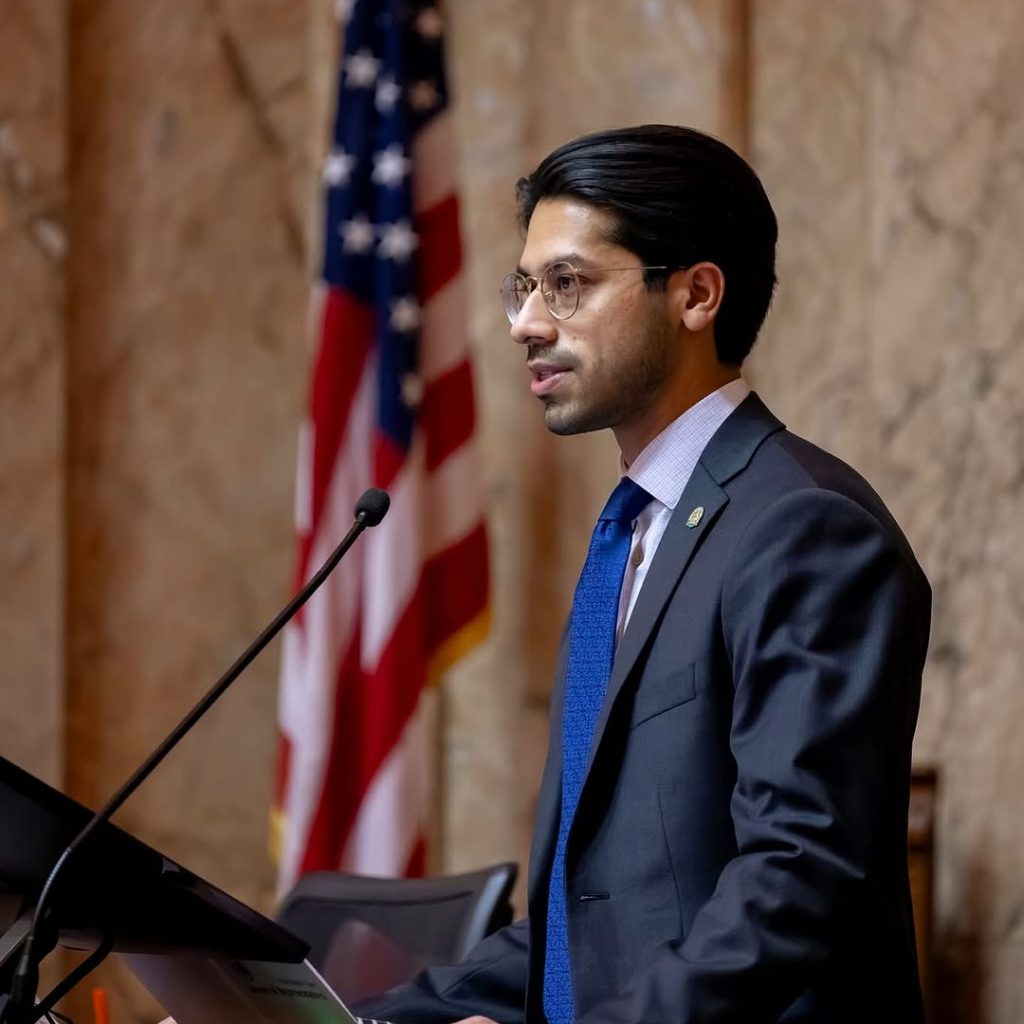
In 2020, Fateh became the first Somali American and first Muslim elected to the Minnesota State Senate. Representing District 62, he emerged as a symbol of a generational and ideological shift within the state’s Democratic-Farmer-Labor Party, campaigning on grassroots organizing and an ambitious progressive agenda.
Now seeking re-election in the Nov. 3, 2026, midterm elections, Fateh has already secured the DFL nomination after winning a competitive primary on Aug. 11. His prospects for returning to the capitol are exceptionally high.
State legislative polling is rare for individual deep-blue Minneapolis districts, but historical voting patterns and robust fundraising heavily favor the incumbent.
By mid-September 2026, state campaign finance filings showed Fateh’s campaign had amassed more than $30,400 in contributions while keeping expenditures low at roughly $11,200, leaving his operation with a healthy cash cushion for the final stretch.
His campaign has emphasized that fundraising, and the turnout it says it reflects, as evidence of continued enthusiasm among working-class and immigrant voters, playing down any threat of a general-election upset.
From Somali immigrant roots to public service
Born in Washington, DC, on April 19, 1990, Fateh is the son of Somali immigrants. His father arrived in the United States in 1963 on an engineering scholarship, instilling in the family a strong emphasis on education.
Fateh followed that path, earning bachelor’s and master’s degrees in public administration from George Mason University before establishing himself in Minneapolis.
Public service has also become a family affair. Fateh lives with his wife, Kaltum Mohamed, and their young son, Imran. His sister-in-law, Zaynab Mohamed, is also a state senator, serving alongside him at the Capitol.
In the Senate, Fateh has sought to translate his activist background into legislation. As chair of the Higher Education Committee, he authored the North Star Promise, a program that provides tuition-free public college for eligible Minnesota families earning less than $80,000.
He also helped lead the fight for protections for rideshare drivers working for Uber and Lyft, including minimum-wage guarantees and job protections. His legislative record includes efforts to legalize fentanyl test strips as a harm-reduction measure aimed at preventing fatal overdoses.
His approach to negotiations has sometimes been confrontational. During the fight over rideshare worker protections, Fateh withheld his vote and stayed away from the Senate floor for more than 10 hours as negotiations approached a critical deadline, seeking better terms for drivers.
The episode illustrated his willingness to challenge party leadership to secure concessions on an issue he considered important.
Vocal critic of Israel
Fateh has also distinguished himself from parts of the Democratic establishment through his criticism of Israel and his advocacy for Palestinians.
He repeatedly accused the Israeli government of committing genocide against Palestinians.
During his mayoral campaign, he also expressed support for the Boycott, Divestment and Sanctions movement against Israel in candidate questionnaires.
Before Minnesota’s March 2024 presidential primary, Fateh announced that he would cast an “uncommitted” protest ballot rather than vote for President Joe Biden.
In a social media statement, he expressed “deep remorse” over the US government’s “unconditional military and political support for Israel,” warning national Democrats against taking progressive voters for granted.
Targeted online for Muslim faith, Somali heritage
Fateh’s prominence has also made him a target of online trolling and right-wing attacks directed at his Muslim faith and Somali heritage.
His supporters see him as a politician willing to challenge established power structures on behalf of immigrant communities and workers, while critics have questioned his methods and decisions — leaving him to navigate the tensions that come with an insurgent political style inside an established party.
Those tensions became particularly visible during his campaign to unseat incumbent Minneapolis Mayor Jacob Frey.
Running on a platform called “Slate for Change,” Fateh advocated a $20 minimum wage, citywide rent stabilization and higher taxes on millionaires. His campaign offered voters a democratic socialist alternative to the city’s political establishment and sought to unite progressive candidates around shared priorities.
Fateh secured more than 60% of delegate support at the Minneapolis DFL convention, but the state party later revoked the endorsement amid internal factional disputes.
His campaign also sought to capitalize on ranked-choice voting by coordinating with other progressive candidates and encouraging their supporters to rank members of the alliance. Fateh urged his own supporters not to rank Frey, a strategy intended to consolidate votes against the incumbent.
The effort ultimately fell short. Fateh lost the ranked-choice contest to Frey, receiving 47% of the vote to the mayor’s 53%.
Although he did not win the mayor’s office, the campaign elevated his profile beyond his state Senate district and reinforced his position as a prominent figure on Minnesota’s progressive left.
Grassroots politics and changing electorate
Fateh’s political approach relies on organizing renters, working-class residents and immigrant communities rather than concentrating solely on conventional party structures. His campaigns emphasize direct engagement with voters and economic policies intended to address the cost of living.
His mayoral bid demonstrated both the potential and the limits of that strategy.
The strong convention showing reflected support among party delegates, while the final election result showed that mobilizing a progressive coalition did not guarantee victory over an incumbent.
For Fateh, the challenge now is to carry that organizing model back into legislative politics as he seeks another term in the Senate.
His career brings together several forces reshaping Minnesota politics: the growing visibility of immigrant communities, generational change within the Democratic Party, demands for stronger worker protections and outspoken opposition to US policy toward Israel and Palestine.
Fateh’s political identity remains rooted in the experience of a first-generation American who has made economic insecurity and representation central to his public message.
Whether he is negotiating over rideshare wages, advocating for tuition-free college or criticizing Washington’s support for Israel, he has built his profile by challenging established positions.
As he returns to the campaign trail, his central test is whether the coalition that carried him into the Senate and propelled his mayoral challenge can continue to sustain his political ambitions.
Related posts


Read also