Ankara park brings centuries of Turkic history together
Monuments, ancient inscriptions, traditional tents and landscaped gardens present shared heritage of Turkic peoples across continents
© File Photo
By Iftikhar Gilani
ANKARA, Türkiye (MNTV) — Visitors walking through the newly developed Beştepe Nation’s Forest in the Turkish capital can travel symbolically from the steppes of Central Asia to the shores of the Mediterranean without leaving Ankara.
According to official project information, the sprawling complex covers 645,000 square metres and contains approximately 750,000 trees and shrubs. Beyond its extensive green spaces, it features historical monuments, ancient inscriptions, traditional tents and cultural displays representing the wider Turkic world.
Developed near Türkiye’s Presidential Complex, the forest is more than another recreational space in the capital. It is an ambitious effort to bring together nature, leisure and the shared historical memory of Turkic peoples whose communities extend from the Balkans and Anatolia to Central Asia, Siberia and western China.
During a visit to the complex, this correspondent found an unusual combination of cultural symbolism and landscape architecture. Rather than presenting history inside a conventional museum, the park places monuments, inscriptions and architectural replicas in an open-air setting.
The project also reflects Türkiye’s growing interest in strengthening cultural connections with the wider Turkic world.
Its development has acquired particular significance following the 13th summit of the Organization of Turkic States (OTS), held in Ankara on October 29 and 30, where leaders discussed closer cooperation in trade, transport, energy, education and cultural affairs.

A cultural village connecting Turkic nations
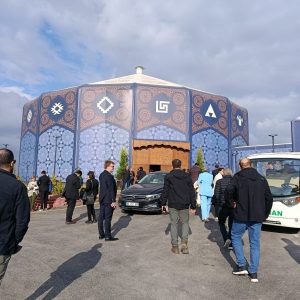
One of the complex’s most distinctive attractions is the Organization of Turkic States Cultural Village, designed to introduce visitors to the traditions and historical landmarks of different Turkic countries.
The village displays flags representing eight countries, cultural exhibits from seven countries and traditional tents associated with six countries.
These displays reflect the diversity of a civilization that developed across an enormous geographical region. The cultural village forms part of a larger heritage complex that includes Bayraktepe and Civilizations Park.
Together, these areas contain 32 miniature replicas of historical landmarks and seven replicas of the Orkhon Inscriptions.
The inscriptions are particularly significant.
Dating from the eighth century, the Orkhon monuments, discovered in present-day Mongolia, are among the earliest surviving major written records of the Turkic language.
They preserve the political ideas, historical experiences and cultural identity of early Turkic rulers. Their presence in Ankara reminds visitors that Turkic history did not begin with the Ottoman Empire or even with the arrival of Turkic dynasties in Anatolia.
It reaches much further back into Central Asian history. For visitors unfamiliar with the region, the displays offer an introduction to a world that has often remained outside mainstream historical narratives.
Civilization divided by modern borders
The cultural village also tells a broader political story.
The modern Turkic world is divided among independent states, autonomous republics and communities living within larger countries.
Türkiye, Azerbaijan, Kazakhstan, Kyrgyzstan and Uzbekistan are full members of the Organization of Turkic States. Hungary, Turkmenistan and the Turkish Republic of Northern Cyprus participate as observers, although Northern Cyprus is recognized as an independent state only by Türkiye.
Beyond these political entities, millions of Turkic-speaking people live in Russia, China and other countries.
They include Uyghurs in East Turkistan, also known as the Xinjiang region of China, Tatars and Bashkirs in Russia, and communities across Siberia and the North Caucasus.
Some of these communities have faced restrictions on their cultural, religious and political freedoms. The Uyghurs, a predominantly Muslim Turkic people, have drawn particular international attention because of Chinese government policies in Xinjiang.
The park does not attempt to address these political questions. Instead, its monuments and cultural displays emphasize a common heritage that predates modern national boundaries.
For Türkiye, such cultural projects form part of a wider effort to strengthen relationships with Turkic-speaking countries through education, tourism, diplomacy and people-to-people exchanges.
The recent Ankara summit reinforced that ambition, with discussions extending to the development of a common Turkic alphabet and greater cultural cooperation.
Forest with 750,000 trees and shrubs
Beyond its historical and political symbolism, the scale of the Beştepe project is impressive.
Developed by the General Directorate of Forestry under Türkiye’s Ministry of Agriculture and Forestry, the forest covers 645,000 square meters, equivalent to 64.5 hectares.
The site contains approximately 750,000 trees and shrubs, including existing vegetation and 410,000 newly planted saplings.
Its botanical collection includes 203 plant species, comprising 72 broadleaved tree species, 27 conifer species and 104 shrub species.
Approximately 285,000 square meters have been developed as lawns.
The result is an extensive landscape of green spaces, wooded sections and themed gardens, offering a contrast to the surrounding urban environment.
The arrangement of pathways, planted areas and cultural installations demonstrates how the designers have sought to combine a public park with an outdoor educational center.
The vegetation also provides a natural setting for the cultural monuments, allowing visitors to move between historical displays and quieter recreational spaces.
Lavender gardens, ancient olive trees and 450-year-old oak
Among the forest’s attractions is a 5,000-square-meter lavender garden containing 19,000 lavender plants. Another section is devoted to medicinal and aromatic plants, with 16 species arranged across 34 plots.
A separate forest fruits garden contains eight species distributed across nine plots.
Perhaps the most interesting botanical attractions, however, are the trees connecting the present landscape with a much older natural history.
The Olive Garden contains ten olive trees estimated to be 300 years old.
Elsewhere stands the Koca Meşe Monumental Oak, believed to be approximately 450 years old. The forest also includes an exhibition area featuring fossilized wood estimated to be 24 million years old.
These installations remind visitors that the natural world has a history far older than the civilizations represented by the surrounding monuments.
For younger visitors, they also offer an opportunity to understand geological time and the importance of protecting natural heritage.
Walking trails, waterfalls, and recreational spaces
The forest has been designed as a recreational destination as well as a cultural attraction.
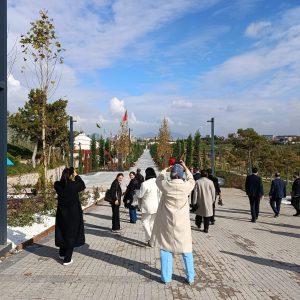
Its network of roads and walking paths extends for more than 19 kilometers, connecting gardens, woodland sections, recreational areas and heritage displays.
A 2.2-kilometer cycling track and a one-kilometer running track provide facilities for visitors seeking exercise.
There is also a 620-meter route featuring wooden footbridges and a viewing terrace. Another walking trail, known as Bayraktepe, extends for 286 meters.
Water plays an important role in the landscape.
The complex includes a six-tiered cascading pool, a 315-meter artificial stream, and a waterfall descending through 26 steps.
A separate ornamental pool stretches 100 meters and covers approximately 750 square meters.
Together, these features create spaces where visitors can spend time away from the traffic and concrete structures of the capital.
The park also includes wooden, stone and grass-covered amphitheaters, offering venues for outdoor gatherings and educational activities.
Recreational facilities for families and children
An important feature of Beştepe Nation’s Forest is its emphasis on family recreation.
Three playgrounds, named after Hezarfen, Barbaros and Evliya Çelebi, cover a combined area of 3,410 square meters.
The names themselves carry historical associations.
Hezarfen Ahmed Çelebi is remembered in Ottoman tradition for his legendary attempt at human flight. Barbaros Hayreddin Pasha was one of the Ottoman Empire’s most celebrated naval commanders. Evliya Çelebi, the 17th-century Ottoman traveler, documented the peoples, cities and cultures of an extensive geographical region.
Their names connect children’s recreational spaces with personalities from Turkish and Ottoman history.
Other facilities include basketball courts, a football pitch, a fitness area and a skateboarding zone. A forest school has also been established to introduce children to the natural environment through outdoor learning.
Cafés and refreshment facilities, including traditional Turkish tea outlets, have been incorporated into the complex.
The project also includes a paddock area with seating for 750 people, four entrance and exit gates, and three car parks.
Map of Türkiye created with living plants
Another distinctive feature of the forest is its use of vegetation to create national symbols.
A living mosaic depicting the map of Türkiye has been developed using 44,000 saplings.
A second installation, representing the Century of Türkiye, contains another 25,000 saplings.
The Century of Türkiye is a national vision promoted by President Recep Tayyip Erdoğan, linking the republic’s second century with ambitions for economic development, technological progress and greater international influence.
In Beştepe, that political vision has been translated into landscape design.
The plant mosaics demonstrate how the forest has been conceived not merely as a recreational facility but also as a space for expressing national identity.
Its location near the Presidential Complex further reinforces that symbolism.
The establishment of the Turkic cultural village comes at a time when Ankara is seeking to expand its influence across Central Asia and the Caucasus.
The Organization of Turkic States has increasingly moved beyond cultural exchanges to discussions about transport corridors, energy networks, trade and defence cooperation.
The Ankara summit adopted a 163-point declaration covering a wide range of areas for cooperation.
A common alphabet, stronger educational links and greater awareness of shared history are among the cultural ambitions associated with the organisation.
The Beştepe cultural village offers a public expression of those objectives, translating the language of summit declarations into something visitors can experience through architecture, inscriptions, traditional dwellings and historical monuments.
Yet the diversity of the Turkic world also presents challenges.
Its peoples follow different political systems, speak distinct though related languages, and have experienced very different historical developments.
Some belong to independent states, while others live as minorities within larger countries. Their religious and cultural traditions also vary.
A common heritage does not necessarily mean identical political interests.
That makes cultural projects such as Beştepe significant, particularly when they encourage visitors to explore both the similarities and differences among Turkic societies.
More than just a park
For Ankara residents, the immediate attraction of Beştepe Nation’s Forest may be its walking trails, gardens, playgrounds and recreational facilities.
For tourists, particularly those visiting from Central Asia and other Turkic regions, the cultural village offers an opportunity to encounter familiar symbols in the Turkish capital.
For students and younger generations, the inscriptions, historical replicas and themed exhibits can serve as an introduction to a history extending across continents.
For Türkiye’s policymakers, the project represents another means of presenting Ankara as a cultural meeting point for the Turkic world.
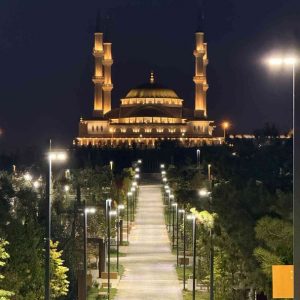
The experience of walking through the park brings these different purposes together.
One moment, visitors encounter a monument recalling the ancient Turkic empires of Central Asia. A short distance away, the landscape opens into gardens, water features and recreational spaces.
This transition between history and nature distinguishes the project from a conventional museum or city park.
The forest also raises a broader question about the relationship between cultural memory and contemporary politics.
Modern borders have divided many communities that once shared languages, traditions and historical experiences. Yet monuments, literature, inscriptions and cultural practices continue to preserve those connections.
Beştepe Nation’s Forest attempts to bring some of these connections into a single public space.
As Ankara promotes the idea of a more closely connected Turkic world, the park offers a tangible expression of that ambition.
Whether political and economic cooperation can eventually match its cultural symbolism remains to be seen.
For now, visitors to this expansive forest in the Turkish capital can walk through landscaped gardens, encounter centuries of history and gain a glimpse of the civilisation linking Türkiye with the distant landscapes of Central Asia.

Read also