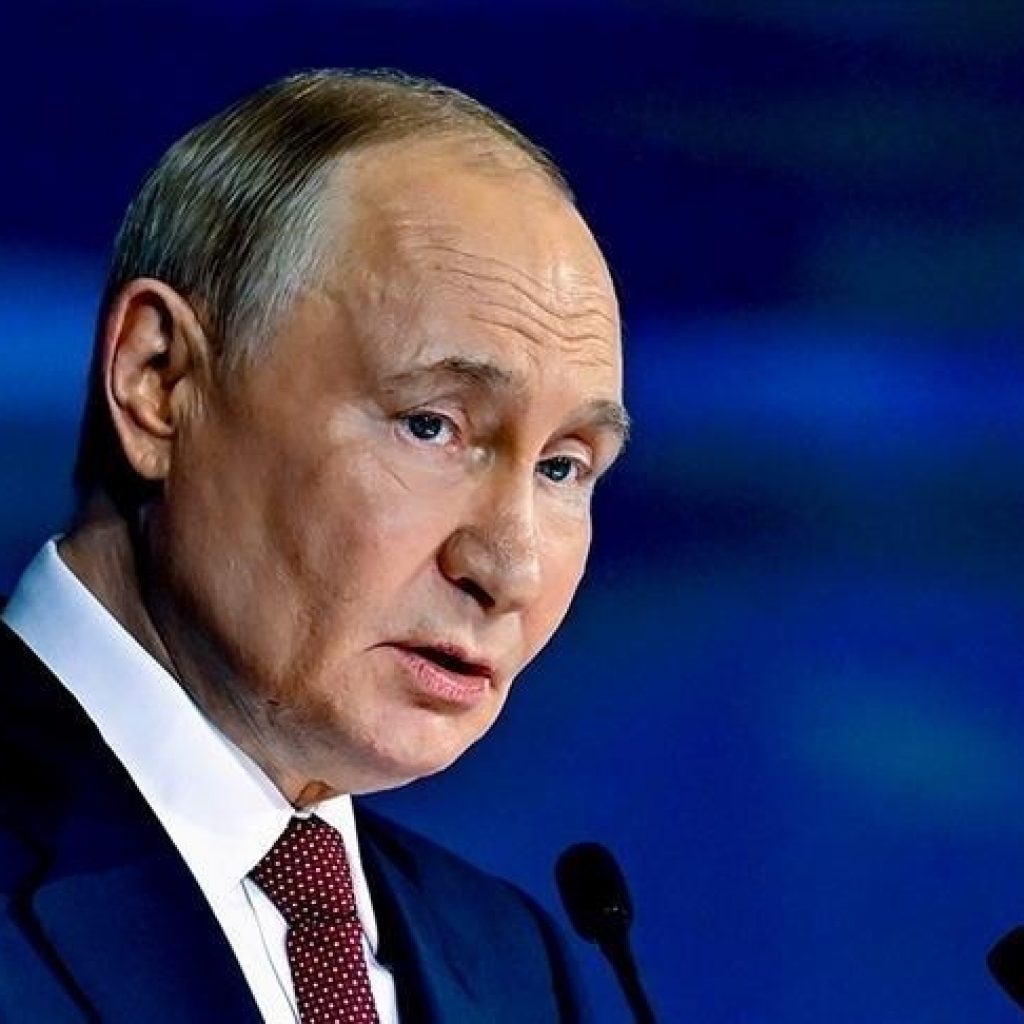
Profile: Ali Larijani, from pragmatic insider to wartime strategist
Larijani finds himself shaping Tehran’s response following US-Israeli air strikes that killed Supreme Leader Ali Khamenei
© Wikimedia Commons
By MNTV Staff Writer
TEHRAN (MNTV) — As Iran confronts one of the most volatile moments in its post-revolution history, one figure has rapidly emerged at the center of decision-making: Ali Larijani.
Long regarded as a calculating insider with a reputation for pragmatism, Larijani now finds himself shaping Tehran’s response following U.S.-Israeli air strikes that killed Supreme Leader Ali Khamenei and senior Revolutionary Guard commander Mohammad Pakpour.
In a televised address shortly after the attacks, Larijani adopted a markedly firmer tone.
He accused Washington and Israel of escalating the conflict and warned that Iran would respond decisively. He also suggested that the United States had miscalculated the consequences of targeting Iran’s top leadership.
Now serving as secretary of Iran’s Supreme National Security Council, Larijani is widely seen as a key architect of Iran’s security posture during this transitional period.
With constitutional mechanisms underway to manage succession and stabilize state institutions, his influence has grown significantly.
Roots in power
Born in 1958 in Najaf, Iraq, to a prominent Iranian clerical family, Larijani comes from one of the Islamic Republic’s most established political lineages.
His father was a respected religious authority, and his brothers have held senior posts in the judiciary and the Assembly of Experts.
His marriage to the daughter of Ayatollah Morteza Motahhari — one of Khomeini’s closest ideologues and a “revolutionary martyr” assassinated in 1979 — embedded him at the very heart of the Islamic Republic’s founding mythology, a connection that has lent him a particular legitimacy few rivals can claim.
Scholar turned statesman
Larijani’s background sets him apart from many of his peers. He trained at the Qom seminary before pursuing a secular education, earning degrees in mathematics and computer science at Sharif University of Technology and later completing a doctorate in Western philosophy at the University of Tehran, focusing on the work of Immanuel Kant.
The combination — clerical formation, scientific training, and philosophical depth — is almost without parallel in Iran’s political class.
He joined the Islamic Revolutionary Guard Corps in the early years after the 1979 revolution, later transitioning into senior state roles. In the 1990s, he served as culture minister.
He then headed Iran’s state broadcasting organization for a decade, a period marked by tight media controls.
From 2008 to 2020, Larijani served three consecutive terms as speaker of parliament. During that time, he played a central role in foreign policy debates, including parliamentary approval of the 2015 nuclear agreement negotiated under former US President Barack Obama.
Political setbacks, strategic return
Despite his establishment credentials, Larijani faced setbacks when he was disqualified from running in the 2021 and 2024 presidential elections.
The Guardian Council cited, among other things, family members’ residence in what it called “belligerent states” — including a daughter studying in the United States — frequent trips abroad, and his political stances during the unrest following the disputed 2009 election.
Larijani dismissed the claims as false. Observers nonetheless saw the move as part of a broader consolidation of power around hardline factions, clearing the field for Ebrahim Raisi’s 2021 victory.
However, he returned to prominence in 2025 when President Masoud Pezeshkian appointed him secretary of the Supreme National Security Council.
The position restored him to the heart of Iran’s security apparatus.
In recent months, Larijani’s rhetoric has grown sharper.
Reports indicated he supported suspending certain levels of cooperation with international nuclear monitors, arguing that external pressure was undermining diplomacy.
A changing tone in a changing moment
The shift had been visible for some time. In March 2025, as U.S.-Iran tensions escalated following President Trump’s letter seeking to reopen nuclear negotiations, Larijani issued a blunt warning: if attacked by the United States, Israel, or their allies, Iran would have no choice but to develop nuclear weapons.
It was a statement that, in retrospect, reads less like a threat and more like a forecast.
Earlier this year, Larijani was reportedly involved in indirect talks with the United States mediated by Oman, describing negotiations as rational but fragile. Those efforts have since collapsed amid the latest escalation.
Following the assassination of Khamenei, Larijani declared that Iran would not negotiate under military pressure. He insisted that the country’s leadership transition was proceeding according to constitutional procedures and warned that any foreign bases used to target Iran could face retaliation.
The conflict has reached into his personal life as well.
His daughter, a physician completing training at a cancer institute in Atlanta, was dismissed from her position after Iranian-American protesters gathered outside her workplace — a reminder that the consequences of the crisis extend far beyond the battlefield.
For a man once seen as a bridge between ideological rigidity and strategic compromise, Larijani’s transformation reflects the broader shift in Iran’s political climate — from cautious diplomacy to open confrontation.
As regional tensions between Iran, Israel, and the United States intensify, his next moves could prove decisive in shaping the trajectory of the conflict.
Related posts


Read also