Pakistan, Saudi Arabia, Türkiye pact details collective defense framework
Full text outlines mutual military assistance, intelligence sharing, joint production and new institutions, while ratification remains pending in Türkiye
© Anadolu Agency
ISLAMABAD, Pakistan (MNTV) — The full text of a joint defense agreement signed by Pakistan, Saudi Arabia and Türkiye in August has emerged, detailing commitments to mutual military assistance, intelligence sharing, joint weapons production and closer coordination among their armed forces.
According to the agreement and reporting by Reuters on October 20, Türkiye has submitted the pact to its parliament for ratification, bringing its provisions into focus more than two months after its signing.
The Makkah Joint Defence Agreement was signed on August 7 by Saudi Crown Prince and Prime Minister Mohammed bin Salman, Pakistani Prime Minister Shehbaz Sharif and Turkish President Recep Tayyip Erdoğan during a summit in Makkah.
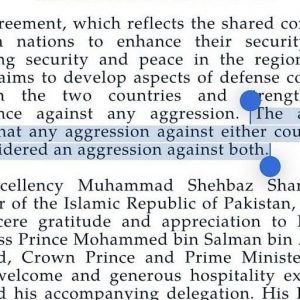
The agreement establishes a framework under which an externally originating armed attack against any one of the three countries will be considered an attack against all three.
However, its provisions leave the precise nature of military assistance dependent on assessments of the circumstances, the assistance required and the capabilities available to each country.
Collective defense and military assistance
Article 2 establishes the pact’s central commitment, requiring the parties to assist a member subjected to an armed attack or military aggression by another country or group of countries. The agreement calls for immediate assistance using the means of mutual support available to the signatories.
The provision does not prescribe an identical military response to every attack. Instead, the parties must assess the assistance required and determine its scope and nature, taking into account available resources, including military capabilities.
The agreement links this commitment to Article 51 of the United Nations Charter, which recognizes the inherent right of individual and collective self-defense in the event of an armed attack.
Article 1 separately commits the three governments to safeguarding their independence, sovereignty, territorial integrity and internationally recognized borders. If these interests are threatened or endangered, the parties agree to use all necessary means to eliminate the threats.
Pakistan’s Foreign Ministry has described the agreement as defensive in nature and said it is not directed against any country. The document’s preamble also emphasizes sovereign equality, noninterference in domestic affairs, international law and the principles of the United Nations Charter.
Although the language establishes a substantial mutual-assistance commitment, it does not specify which country must deploy particular forces, provide particular weapons or undertake a particular military operation in every possible contingency.
Permanent committee to coordinate defense policy
Article 8 establishes a Strategic Political and Defence Committee comprising the foreign ministers, defense ministers and chiefs of general staff of the three countries.
The committee is responsible for providing strategic direction for joint defense, developing security cooperation and resolving obstacles to implementation. It must meet twice a year, with the host country rotating among the three signatories.
The agreement also allows the three national leaders to meet annually if considered necessary. The committee may establish subcommittees and negotiate additional agreements or protocols to implement specific areas of cooperation.
Decisions on admitting additional members must be approved by consensus among the original signatories, which retain authority over the agreement’s institutional development.
The pact further provides for a permanent secretariat headquartered in Saudi Arabia. Its secretary-general will serve a three-year term, with the position rotating among the three founding members. Pakistan is designated to provide the first secretary-general.
The institutional framework is intended to move cooperation beyond occasional political meetings by creating mechanisms for regular consultations, implementation and coordination among the countries’ defense establishments.
The three governments had already taken steps toward this structure before the full agreement came into focus. On August 31, their strategic committee met in Istanbul and agreed to further institutionalize cooperation, strengthen collective deterrence and expand joint defense-industry activities.
Joint production and defense technology
Articles 3, 6 and 7 establish a framework for closer military cooperation, including personnel exchanges, joint exercises, technology sharing and collaborative weapons production.
Article 6 calls for reciprocal exchanges among defense institutions, joint training programs, military exercises and deployments intended to improve interoperability. These activities are designed to help the three countries’ armed forces coordinate more effectively in peacetime and wartime.
Article 7 provides for technology sharing among defense-industry institutions, joint technological development, collaborative production and cooperation between defense-industry organizations.
The agreement identifies several areas of cooperation, including joint production, research and development in specialized technologies, training by experts from participating countries, and the exchange of technical knowledge and lessons learned.
These provisions could support expanded defense-industrial partnerships among Pakistan, Saudi Arabia and Türkiye. Türkiye has an established defense manufacturing sector, while Pakistan has experience in military production and Saudi Arabia has pursued greater development of its domestic defense industry.
However, the agreement does not identify particular weapons systems, production facilities, procurement targets or financial commitments. Individual projects would require further negotiations and mutual agreement.
Article 3 also calls for closer cooperation in defense, defense industry and security, alongside activities intended to strengthen relations among the three countries’ armed forces.
Intelligence sharing and logistical support
The pact establishes additional mechanisms for intelligence exchange and military logistics.
Article 9 requires the parties to share intelligence through mutually agreed secure channels while observing information-security, data-protection and confidentiality requirements.
Article 13 further restricts access to classified information to individuals with appropriate security clearances and a legitimate need to know. Classified material obtained under the agreement cannot be shared with states, companies or individuals outside the participating countries.
These provisions create a formal framework for exchanging sensitive information while imposing safeguards on its handling and disclosure.
Article 10 addresses logistical support, requiring the parties to assist one another in peacetime, wartime and other emergencies, subject to the availability and compatibility of logistical services.
The listed supplies include weapons, ammunition, fuel, spare parts and other equipment. The agreement does not, however, specify fixed quantities, delivery schedules or automatic supply arrangements.
The practical extent of such assistance would depend on the countries’ available resources, operational requirements and subsequent arrangements.
Counterterrorism and regional coordination
Article 5 commits the three countries to strengthening existing cooperation against terrorism in all its forms and manifestations that adversely affect regional and international stability.
The agreement calls for joint efforts at the operational level, alongside regular consultations on international security matters. Article 4 requires the parties to develop individual and joint measures based on common assessments to protect their vital interests and national security.
The preamble also emphasizes cooperation in regional and international organizations, including efforts to adopt common positions on international issues.
Together, these provisions extend the partnership beyond military responses to external attacks. They establish a broader framework for political consultation, counterterrorism cooperation and coordination over regional security challenges.
The agreement does not name a specific adversary or identify a particular country against which the partnership is directed. Its stated principles emphasize sovereignty, territorial integrity, international law and regional stability.
Ratification and long-term obligations
Article 16 stipulates that the agreement must be ratified under the procedures applicable in each participating country. It will enter into force when the final instrument of ratification is deposited with the secretariat of the Strategic Political and Defence Committee.
Türkiye’s submission of the agreement to parliament on October 20 marks a step in its domestic approval process. The pact’s entry into force remains governed by the ratification provision, rather than by the date of its original signing.
Once in force, the agreement will remain valid indefinitely. However, any party may withdraw after ten years have elapsed from its entry into force, provided it gives the other signatories written notice through diplomatic channels at least three months in advance.
Withdrawal or termination would not automatically end projects and activities agreed upon before the relevant date. Obligations governing the protection of classified information would also continue.
Article 12 states that the pact does not prejudice rights and obligations arising from international agreements the parties have previously concluded.
Article 14 requires disputes over interpretation or implementation to be resolved amicably through consultations, while Article 15 requires unanimous agreement among the core parties for amendments.
The agreement therefore establishes an extensive framework for collective defense, military coordination and industrial cooperation, while leaving important operational details to subsequent decisions.
Its significance will depend on how Pakistan, Saudi Arabia and Türkiye translate the commitments into practical arrangements, including military planning, intelligence exchange, logistical support and joint production.
The full text clarifies the intended scope of cooperation, but the precise response to any future attack will depend on the circumstances and the assistance the parties determine they can provide.



Read also