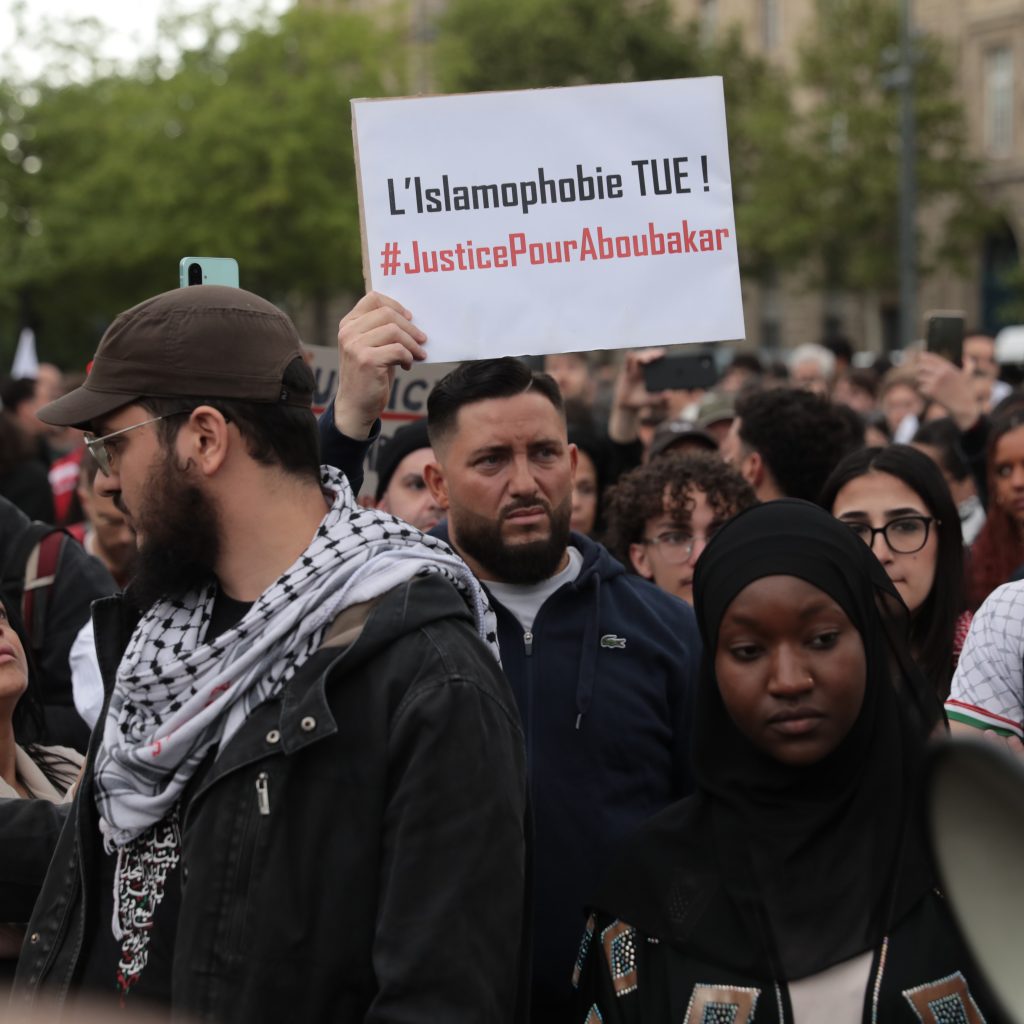
Islamophobia in Europe: Dutch police assault on Muslim women sparks protests, highlights growing crisis
Rights groups warn of systemic discrimination as governments across continent tighten restrictions on Muslim communities
© AA
UTRECHT, Netherlands (MNTV) — Dutch authorities have launched an investigation into possible racially motivated violence after a police officer was filmed assaulting two Muslim women in Utrecht, an incident that has sparked protests and renewed concerns about the rising tide of Islamophobia across Europe.
The incident occurred on the evening of Jan. 26 outside the Hoog Catharijne shopping mall. Video footage that went viral on social media shows an officer striking the women with a baton and kicking one of them in the stomach.
Police said in a statement that all available footage, including body camera recordings, would be thoroughly reviewed as part of a comprehensive investigation.
One of the women was detained on suspicion of insulting an officer, authorities said.
A police spokesperson acknowledged the strong public reaction to the footage, telling Dutch public broadcaster NOS that it has raised “particularly serious questions related to racism.”
Anis Boumanjal, the women’s lawyer, told NOS that the officer made several racist remarks during the encounter, including “You don’t belong in this country.”
He said both women sustained injuries and are receiving medical treatment.
Protesters demand accountability
Hundreds gathered Thursday in Utrecht’s Vredenburg Square to protest what organizers called “racist violence” by police.
Demonstrators argued the assault was not an isolated incident, saying racist violence occurs “systematically and repeatedly” within Dutch law enforcement.
They demanded the officer’s suspension, a public apology from police, and guarantees that such incidents will not recur.
Protesters chanted “No justice, no peace,” “No to racist police” and “Fascist police, stop the terror” before marching to the Paardenveld police station.
Rights groups sound alarm on coalition plans
The incident comes as Dutch human rights organizations express mounting concern about the trajectory of government policy toward Muslims and refugees.
The Muslim Platform of the Netherlands, which represents regional mosque networks, criticized the absence of explicit measures addressing Islamophobia and anti-Muslim sentiment in the new coalition agreement between D66, VVD and CDA.
“This is incomprehensible at a time when Muslims face structural exclusion and hostility, including from government actions,” the organization said, citing mosque surveillance, banking restrictions affecting Muslim institutions, and citizens wrongly listed as suspected terrorists.
The platform also expressed concern about proposals related to foreign interference oversight, surveillance of religious institutions and the creation of blacklists for imams.
Amnesty International called the coalition’s refugee policies “deeply concerning,” warning that proposals to expand immigration detention, remove medical advice from asylum procedures and amend the UN Refugee Convention would further erode protections.
“For years, the political debate has stigmatized and dehumanized people who are fleeing. It is shocking to read that the rights of those fleeing war and persecution are being further eroded,” the organization said.
The Dutch Red Cross warned that plans for asylum procedures outside the EU and increased detention “present a risk to fundamental rights.”
International solidarity
The Council on American-Islamic Relations, the largest Muslim civil rights organization in the United States, expressed solidarity with the Dutch Muslim community.
“We stand in solidarity with the Muslim community in the Netherlands as they seek justice, transparency and accountability following these disturbing reports of police violence against Muslim women,” CAIR said in a statement.
“No one should be targeted, abused or humiliated because of their faith, ethnicity or appearance.”
The organization noted that Muslim women are disproportionately impacted by Islamophobia, racial profiling and violence globally.
A continental crisis
The Utrecht incident reflects a troubling trend across Europe, where Muslim communities face mounting hostility from both state actors and society at large.
CAIR has described Islamophobia as “spinning out of control” in Europe, pointing to a pattern of incidents across multiple countries. In recent months alone, the organization has documented hate incidents targeting Muslims in Scotland, Germany, Ireland and the Netherlands, including mosque vandalism and discriminatory legislation.
Last month, Austria voted to ban headscarves in schools for girls under 14, a measure critics say will further marginalize Muslims.
In the Netherlands specifically, the pattern extends beyond individual acts of violence. Muslim communities have faced systematic surveillance of mosques, discriminatory banking practices that have cut off financial services to Islamic institutions, and wrongful placement on terrorism watchlists, all documented by Dutch Muslim organizations.
The coalition government’s reluctance to explicitly address Islamophobia while simultaneously proposing expanded surveillance of religious institutions and imam blacklists suggests that policy is moving in the opposite direction from what Muslim communities and rights groups are demanding.
As protesters in Utrecht made clear, they view the assault on the two women not as an aberration but as a symptom of deeper institutional problems.
Whether European governments respond with meaningful reform or continued denial will determine the future of Muslim civil rights across the continent.
Related posts


Read also