How is the world reacting to the US-Israeli strikes on Iran and Tehran’s retaliation?
Governments and international organisations have responded with alarm after US and Israeli strikes on Iran
© AA
WASHINGTON/TEHRAN (MNTV) — Governments and international organisations have responded with alarm after U.S. and Israeli strikes on Iran were followed by Iranian missile and drone attacks across the region, raising fears of a broader war.
European Union and Europe
European Commission President Ursula von der Leyen and European Council President Antonio Costa described the confrontation as “greatly concerning” and urged all sides “to exercise maximum restraint, to protect civilians, and to fully respect international law”.
France, Germany and the United Kingdom issued a joint statement condemning Iranian attacks on countries in the region while reaffirming their commitment “to regional stability and to the protection of civilian life.”
French President Emmanuel Macron called for an urgent UN Security Council meeting, warning the escalation carries “serious consequences” for international peace and security. “The current escalation is dangerous for everyone. It must stop,” he said.
British Prime Minister Keir Starmer reiterated that London “played no role in these strikes” and said the U.K. had strengthened protections for its regional bases and personnel.
Spain’s Prime Minister Pedro Sanchez criticised what he called “unilateral” military action by Washington and Israel and demanded “immediate de-escalation and full respect for international law,” while also rejecting the actions of the Iranian government.
Norway’s Foreign Minister Espen Barth Eide questioned Israel’s claim of preventive action, saying such strikes are lawful only in the face of an imminent threat.
Belgian Foreign Minister Maxime Prevot said the Iranian people “must not pay the price for their government’s choices,” and expressed regret that diplomacy had failed.
Ukraine’s Foreign Ministry placed responsibility on Iran for the broader crisis, citing domestic repression and regional actions as contributing factors.
Gulf and Middle East
Qatar condemned Iranian missile fire on its territory, calling it a flagrant violation of sovereignty and saying it reserves the right to respond under international law.
The United Arab Emirates described the strikes on its territory as “a dangerous escalation and a cowardly act that threatens the security and safety of civilians,” adding that it has the “full right” to respond.
Bahrain confirmed that an Iranian missile targeted the headquarters of the U.S. Navy’s Fifth Fleet and labelled the attack “treacherous.”
Kuwait denounced the strike on its soil as a “flagrant violation” of international law and warned that further escalation would deepen regional instability.
Saudi Arabia condemned the Iranian attacks in the “strongest terms” and cautioned against “dire consequences.”
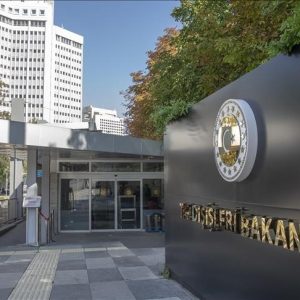
Turkiye’s Foreign Ministry called on “all parties” to halt the spiral of violence, noting that the crisis began with US-Israeli strikes on Iran and warning the escalation risks regional and global stability.
Oman, which had been mediating indirect U.S.-Iran talks, expressed dismay. Foreign Minister Badr Albusaidi said the violence would not serve US interests or global peace and urged Washington “not to get sucked in” further.
Oman’s Foreign Ministry also called for an emergency UN Security Council session and an immediate ceasefire.
Pakistan’s Foreign Minister Ishaq Dar “strongly condemned the unwarranted attacks against Iran” and called for urgent diplomacy.
Russia and China
Russian President Vladimir Putin convened his security council to assess developments. The Russian Foreign Ministry described the strikes as reckless and destabilising, urging the international community to deliver an objective assessment.
Dmitry Medvedev, deputy chairman of Russia’s Security Council, accused Washington of using nuclear negotiations as cover for military action.
China’s Foreign Ministry called for “an immediate halt to military actions” and emphasised that “Iran’s national sovereignty, security and territorial integrity should be respected,” urging a return to dialogue.
South and East Asia
India’s Ministry of External Affairs called for restraint and respect for sovereignty, saying “dialogue and diplomacy should be pursued.”
The statement followed Prime Minister Narendra Modi’s recent visit to Israel, where he described bilateral ties as “vital.”
Malaysia also strongly condemned the attacks against Iran and the subsequent retaliatory attacks by Iran.
“The attacks violate the principles of sovereignty and territorial integrity, as well as the prohibition against the use of force under the Charter of the United Nations and international law,” the foreign ministry statement read.
“At this critical juncture, all parties must exercise maximum restraint to prevent further escalation that could destabilise the region and carry wider global consequences. Malaysia reiterates that disputes must be resolved through dialogue and diplomacy, in full respect of international law,” it added.
United States
Domestic political divisions have also surfaced in Washington. Republican Congressman Thomas Massie said he is “opposed to this war” and called for a Congressional vote.
Democratic Senator Ed Markey described the strikes as “illegal and unconstitutional,” warning of the risk of a wider regional war and urging a diplomatic solution.
Americas
Chile’s Foreign Ministry has expressed “concern for the grave military escalation in the Middle East”.
“The government of Chile condemns the attacks against Iran perpetrated by the United States and Israel, as well as the response of the Iranian regime against Israel and the Gulf countries,” it said.
“These actions, in a highly tense regional context, could have consequences for the stability of the region and international security.”
Venezuelan government also denounced the attacks on Iran.
“Venezuela condemns and regrets deeply that, in a context in which diplomatic efforts and ongoing negotiations are being developed, the military route was opted for, through attacks against Iran,” it said in a statement.
The government added that this caused an escalation, including the “undue and condemnable military reprisals against targets located in different countries of the region by Iran.”
International organisations
International Committee of the Red Cross President Mirjana Spoljaric warned that “a dangerous chain reaction” of escalation is under way, with potentially devastating consequences for civilians, and called for respect for the laws of war.
UN High Commissioner for Human Rights Volker Turk said he deplored the strikes by Israel and the United States and Iran’s retaliation, stressing that civilians ultimately bear the cost of armed conflict.
He urged all sides to return to negotiations.
As diplomatic appeals intensify, the breadth of reactions underscores global concern that the confrontation between Washington, Tel Aviv and Tehran could spiral into a prolonged and destabilising regional war.
Read also