Gaziantep turns cuisine into Türkiye’s language of soft power
At Turkish Cuisine Week, Gaziantep presents food not only as heritage, but as diplomacy, memory and a bridge across cultures.
Iftikhar Gilani
GAZIANTEP, Turkiye (MNTV) – The first lesson Gaziantep teaches a visitor is that food here is not served in a hurry. It arrives with memory, patience, and pride.
In the old quarters of this southeastern Turkish city, smoke rises slowly from charcoal grills, baklava dough is rolled until it is almost transparent, and copper trays move from kitchen to table like carriers of history.
Before the kebabs arrive, there is yogurt, thick and cool, mixed with herbs and tiny meat granules, resembling a richer version of raita familiar to South Asian palates. Then come the kebabs, not one kind but many, each cut, minced, spiced, and grilled with a precision that explains why Gaziantep speaks of cuisine as an art form rather than a daily necessity.
This was the setting for “Türkiye’s Gastro-diplomacy Model: Table and Heritage,” held in Gaziantep as part of Turkish Cuisine Week, celebrated from May 21 to 27 under the theme “Heritage at a Table.”
The program, organized under the patronage of Turkish first lady Emine Erdoğan, brought together officials, academics, chefs, gastronomy writers, business owners, journalists, and content creators in the city.
The choice of Gaziantep was not accidental. It is Türkiye’s first city that comes to mind when gastronomy is mentioned. Its culinary museum opened in 2008, and in 2015 the city joined the UNESCO Creative Cities Network for Gastronomy, giving international recognition to a food culture shaped by cereals, spices, dried fruits, pistachios, and centuries of exchange.
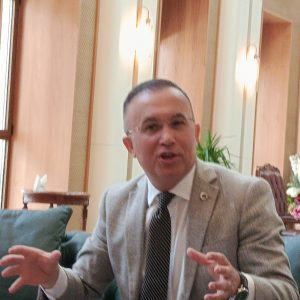
“If the world were a house, the kitchen of that house would be Gaziantep,” Governor Kemal Çeber said to the journalists.
The line drew applause, but after a few days in the city, it felt less like a slogan and more like a statement of fact. Gaziantep does not merely cook. It remembers through cooking.
Gastronomy writer and researcher Özden Mermer Özsabuncuoğlu said the city’s food culture was shaped by geography, trade, and season.
“You come across food as per season,” she said. “Since Gaziantep was on the Silk Road, it synthesized the food. Lahmacun is different in summer and different in winter. The city has food of any choice. People of Gaziantep have turned food into art. They live to eat rather than eat to live.”
That sentence explains much about the city. Here, even a simple meal carries a sense of occasion. A table may begin with yogurt, olives, herbs, bread and small starters before moving toward lahmacun, grilled lamb, hand-minced kebabs, stews, roasted vegetables, pistachio dishes, and finally baklava layered with such delicacy that it seems closer to embroidery than dessert.
Coşkun Koçak, a baklava master and business owner, said Gaziantep’s taste cannot be copied merely by following a recipe.
“What makes Gaziantep food different is that climate and water are important in food,” he said. “The same food will have a different taste if prepared in another geography. Quality of baklava depends on the raw material and also the season.”
Inherited craft
Burhan Çağdaş, a fourth-generation baklava and kebab master, spoke with the authority of inherited craft. “The dough of baklava has to be thin,” he said. “We do not use machines for mincing meat, but a special mincing knife.”
That insistence on hard work is visible everywhere. In the kitchen of Gaziantep Mutfak Sanatlari Merkezi, the chefs were not crushing meat into a uniform paste but chopping it by rhythm and experience.
In another, baklava sheets were stretched so thin that light passes through them. The city’s famous pistachio appears not as decoration but as identity. It is in sweets, savoury dishes, and the pride of shopkeepers who explain its color, oil, and timing of harvest with the seriousness of archivists.
Yet the Gaziantep event was about more than local pride. It was about how food can become diplomacy.
Academic material discussed during the program defines gastro-diplomacy as a public diplomacy activity that attracts people through food, supports cultural diplomacy, and contributes to nation branding. Cuisine, it argues, is not only food and drink but a cultural structure that includes service, preservation, table rituals, and beliefs around the kitchen.
That idea was repeatedly echoed during the program. Military power may change a battlefield or the status quo, but soft power builds relationships. Food can reshape perceptions beyond politics and security narratives. Countries such as Italy, South Korea, Japan, and Thailand have used gastro-diplomacy extensively, and Türkiye is now trying to place its own culinary heritage more firmly in that global conversation.

Dr. Fulya Harp Çelik, a faculty member in gastronomy and culinary arts at Hasan Kalyoncu University, said Türkiye has a natural advantage because of its history, geography, and habit of mediation.
“Turkey can unite at many points in terms of gastro-diplomacy, since it is always a mediator in normal diplomacy and has a very rich cuisine,” she said. “If we express ourselves in this arena, we can really come to very different places in our own advertising and branding.”
Gaziantep makes that argument persuasive because its food is already a map of encounters. The city stood on routes linking Anatolia, Mesopotamia, Syria, Iran, and beyond. Its cuisine carries traces of Arab, Ottoman, Anatolian, and broader Islamic culinary worlds, while remaining distinctly local.
For Muslim visitors, many flavors feel familiar: yogurt with meat, grilled lamb, bread from hot ovens, spice-balanced stews, hospitality built around the guest. But the methods, the pistachio, the copperware, and the seasonal logic give Gaziantep its own signature.
Deputy Mayor Feray Yılmaz said the table in Gaziantep is not only a place for eating. It is where sharing, friendship, solidarity, and the culture of living together are passed to future generations. She said the municipality promotes local cuisine through the Culinary Arts Training Center and through vocational courses for women and young people.
“We support gastronomy in every field,” Yılmaz said. “We know that the municipality’s duty is not just about building roads and bridges; it also involves creating visionary projects that will open doors for young people through cultural and artistic projects.”
Food and hospitality go together
The social meaning of food is especially visible in Gaziantep’s recent history. Governor Çeber said the city, with a population of about 2 million, has also hosted large numbers of Syrians. “When the Syrian crisis began, we hosted 500,000 people at one time,” he said. “We did not put them in camps. Every home in Gaziantep welcomed them and hosted them.”
That hospitality is not separate from the city’s food culture. In Gaziantep, feeding someone is not a performance. It is a moral language. The program also sought to turn that moral language into policy. A workshop on “Gastro-diplomacy Model and Cooperation Mechanisms for Gaziantep” discussed how the city’s culinary identity, local memory, and traditional production culture can be transformed into a sustainable model linked to the Türkiye brand. The event included panels, tasting sessions, workshops, and cultural city tours for media and content creators.
For Türkiye, the stakes are significant. The country’s cuisine is one of the richest in the world because of nomadic traditions, Ottoman palace culture, Islamic dietary habits, Mediterranean produce, Mesopotamian grains, Asian spices, and the coexistence of many communities across Anatolia. Scholars argue that Turkish cuisine offers a strong opportunity for public diplomacy and national branding because it speaks directly to memory, emotion, and taste.
Gaziantep is one of the strongest examples of that opportunity. It is not only a food city but also an industrial and regional center, connected economically to southeastern Türkiye and neighboring Syria, Iraq, and Iran. It has 24 museums, one of Europe’s largest zoos, and a strong tradition of machine-made carpet production. It also contains religious memory, including a revered place dedicated to Sa’d ibn Abi Waqqas near the Araban district, linked to early Islamic campaigns in the region, though his actual burial place is in Madina.
The result is a city where cuisine, commerce, faith, migration, and memory are layered together.
At the dining table, those layers become visible. A visitor may begin with yogurt and meat, move to spicy lahmacun, taste several varieties of kebab, pause over roasted peppers and fresh bread, then end with baklava and Turkish coffee. But what remains is not simply the flavor of grilled meat or pistachio. It is the sense that Gaziantep has made food a way of telling its story to the world.
That is why the event’s title, “Table and Heritage,” was well chosen. In Gaziantep, the table is not a decorative metaphor. It is the archive, the classroom, the embassy, and the family album.
Gaziantep’s culinary identity is inseparable from its layered history.
In the city’s old bazaar stands the historic Tahmis Coffee House, which local historians and residents proudly describe as perhaps the world’s oldest continuously operating coffee shop, serving customers since 1635 during the Ottoman era.
For centuries, merchants, travelers, and storytellers gathered there over thick Turkish coffee as caravans moved along the Silk Road routes linking Anatolia to the Arab world and Persia.
The city itself was historically known simply as Antep, but its modern name emerged from the Turkish War of Independence. After the collapse of the Ottoman Empire, local resistance fighters battled French occupation forces in one of the fiercest campaigns of the independence struggle.
Following victory, the Turkish parliament awarded the city the honorific title “Gazi,” meaning victorious or veteran, turning Antep into Gaziantep.
Local historians also recall an emotional connection with Mustafa Kemal Atatürk, whose birthplace, Thessaloniki, historically known in Turkish as Selanik, became part of Greece after the Ottoman retreat from the Balkans. Residents of Antep are said to have offered Atatürk citizenship and even a residence in their city, deepening the bond between the republic’s founder and this historic southeastern Anatolian center.
The Gaziantep model offers a larger lesson: diplomacy does not always begin with treaties, flags, or press conferences. Sometimes it begins when strangers sit together, break bread, taste one another’s food, and discover that culture can travel farther than politics.
In Gaziantep, Türkiye is betting that the world can be reached not only through policy statements but through kebabs, yogurt, pistachios, and baklava. And judging by the tables of this city, it is a language many people may understand.


Read also