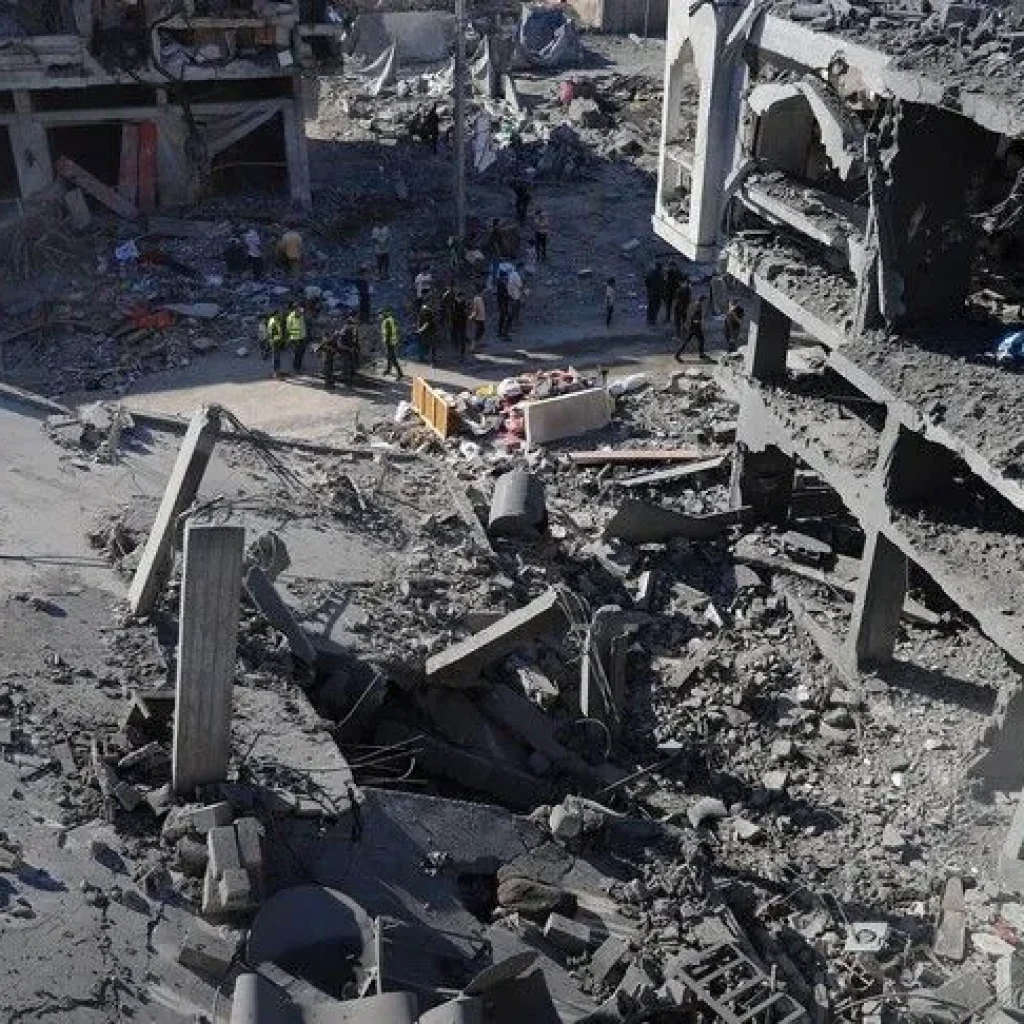
Gazans return to shattered homes as ceasefire begins
Thousands trek north after Israeli troops begin phased withdrawal under U.S.-brokered agreement to end two-year war
© Anadolu Agency
GAZA, Palestine (MNTV) — Palestinians journey across the devastated landscapes of Gaza, returning to the ruins of their former homes after a long-awaited ceasefire took effect and Israeli troops began withdrawing from several urban areas under a U.S.-brokered peace plan.
Long lines of families walked north along the coastal highway toward Gaza City — once a bustling urban center, now reduced to rubble after one of Israel’s ruthless genocide of Palestinians.
“Thank God my house is still standing,” said resident Ismail Zayda from Gaza City’s Sheikh Radwan district. “But everything around it is destroyed. My neighbors’ homes are gone.”
In southern Gaza, residents made their way through what was once Khan Younis, now a vast wasteland of collapsed buildings. Carrying mattresses and salvaged wood, they searched for any remnants of their lives. “We went back, but our area was exterminated,” said Ahmed al-Brim, who returned to find only debris. “We couldn’t even retrieve clothes or furniture — nothing remains.”
The Israeli military confirmed that the ceasefire came into effect at noon local time, marking the first stage of a broader plan led by U.S. President Donald Trump to end the two-year war.
The agreement requires Israel to withdraw from most urban positions within 24 hours while maintaining security control over parts of the enclave.
Prime Minister Benjamin Netanyahu said Israel would remain in Gaza until Hamas was fully disarmed. “If disarmament happens the easy way, good. If not, it will happen the hard way,” he said in a televised address.
As Israeli roadblocks were lifted, crowds surged northward toward their hometowns. “Even if it’s just rubble, it’s home,” said Mahdi Saqla, 40, as his family set out for Gaza City. “After two years of suffering, returning is our greatest joy.”
The ceasefire deal, ratified by Israel’s cabinet early Friday, stipulates that Hamas will release 20 remaining Israeli hostages within 72 hours.
In exchange, Israel will free 250 long-term Palestinian prisoners and 1,700 detainees arrested during the war. The agreement also opens Gaza’s crossings to hundreds of daily aid trucks delivering food and medical supplies.
Israeli military spokesperson Brig. Gen. Effie Defrin urged residents to avoid reentering areas still under military oversight. Meanwhile, Hamas’s Gaza leader Khalil Al-Hayya announced that he had received “guarantees from the United States and mediators that the war is over.”
The ceasefire ends Israel’s war on Gaza, which quickly turned into what independent observers called a ‘gonocide’ of Palestinian that killed over 67,000 Palestinians, mostly women and children, and left Gaza in uninhabitable ruins.
However, challenges remain. Hamas has given Israel the prisoners list which includes Marwan Barghouti, Ahmad Saadat, Hassan Salameh, and Abbas al-Sayyed — all seen by Palestinians as symbols of resistance — who are not released by Israel.
Another unfinalized issues remains of Hamas’ status in the future of Gaza, and its disarmament under US-Israeli pressure, a condition that the movement is trying hard to resist.
Gaza’s interior ministry said it would deploy local security forces in vacated zones, though it was unclear how the security would realized in such a condition.
President Trump announced plans to visit the region on Sunday for a possible signing ceremony in Egypt, followed by meetings in Israel early next week — signaling a cautious but significant step toward ending one of the bloodiest chapters in the region’s history.
Related posts


Read also