BJP leader defends Muslim-less national cabinet
Rights advocates say remarks normalize political exclusion and reveal deepening majoritarian governance under Modi as India’s 200 million Muslims face widening discrimination
© File Photo
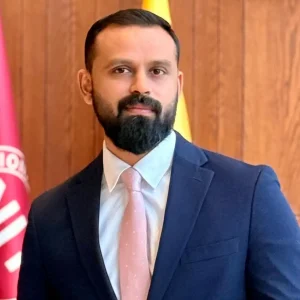
NEW DELHI, India (MNTV) — A senior leader of India’s ruling Bharatiya Janata Party (BJP) has publicly defended the complete absence of Muslim representation in the country’s national cabinet, saying the Muslim community has only itself to blame because it does not vote for the party.
Speaking at a press conference in Kozhikode, in the southern state of Kerala, state BJP president and former Union Minister Rajeev Chandrasekhar said his party was not responsible for the exclusion of Muslims from the highest levels of India’s government.
“Muslims are not voting for us. What can we do if the community is not supporting us?” he said. “There are no ministers in the Union cabinet because there are no MPs from the community.”
India’s Hindu nationalist BJP, which has governed the country since 2014 under Prime Minister Narendra Modi, currently has no Muslim parliamentarian in either house of Parliament — the first such instance in India’s post-independence history. As a result, the country of nearly 200 million Muslims — the world’s largest Muslim minority population — has zero Muslim ministers in the federal cabinet.
Chandrasekhar insisted the absence of representation did not amount to discrimination. “We have not hurt anyone… that trust has not been there,” he said, questioning why Muslims overwhelmingly vote for opposition parties such as the Congress.
His remarks sparked strong criticism from political analysts and rights groups, who said the statement reflects a majoritarian model of democracy in which representation is reduced to an electoral reward rather than a constitutional guarantee.
Observers say the comments normalize political exclusion at a time when Indian Muslims face growing marginalization through discriminatory laws, hate speech, vigilante violence, bulldozer demolitions of Muslim homes, and mass incarceration under anti-terror legislation.
Analysts note that the absence of Muslims in national leadership coincides with the BJP’s ongoing campaign to reshape India into a Hindu-majoritarian state, consolidating power by portraying Muslims as politically undesirable.
Critics argue that linking basic political representation to voting patterns fundamentally undermines India’s secular constitution and the principle of equal citizenship.
Chandrasekhar pointed to earlier Muslim leaders in the BJP, including Shahnawaz Hussain and Mukhtar Abbas Naqvi, as evidence that the party had historically included Muslims.
However, rights advocates say contemporary political realities — from the Citizenship Amendment Act (CAA) to the National Register of Citizens (NRC), and widespread Islamophobic rhetoric — have entrenched an environment in which Muslims are structurally excluded from power.
The remarks come months before key state elections in 2026 and ahead of the 2029 national election, as India continues to confront widening concerns about democratic backsliding, authoritarian governance, and the shrinking space for minorities.


Read also