
Trump pressures world powers to help reopen Strait of Hormuz as Iran tightens grip
President urges China, France, Japan, South Korea and Britain to send ships to escort tankers through waterway
© AA
WASHINGTON, United States (MNTV) – U.S. President Donald Trump has pressed NATO allies and China to help reopen the Strait of Hormuz after Iran effectively closed the critical oil transport corridor in retaliation for the U.S.-Israeli war, as global oil prices surged 40 to 50 percent and regional attacks spread across the Middle East.
Trump called on China, France, Japan, South Korea and Britain to send ships to escort tankers through the strait, receiving only guarded responses.
“It’s only appropriate that people who are the beneficiaries of the strait will help to make sure that nothing bad happens there,” Trump told the Financial Times, warning that a failure to respond would be “very bad for the future of NATO.”
He also threatened to delay a planned summit with Chinese leader Xi Jinping later this month if Beijing does not assist.
Japan said Monday it was “not at the moment considering issuing a maritime security operation,” with Defense Minister Shinjiro Koizumi telling parliament the country had not made such a decision. Australia’s transport minister also said the country would not be sending a naval vessel.
“We won’t be sending a ship to the Strait of Hormuz,” Transport Minister Catherine King told national broadcaster ABC.
Iran warned other countries against getting involved in the war. Foreign Minister Abbas Araghchi, in a call with his French counterpart Jean-Noel Barrot, called on nations to “refrain from any action that could lead to escalation and expansion of the conflict,” and on X urged neighboring countries “to expel foreign aggressors.”
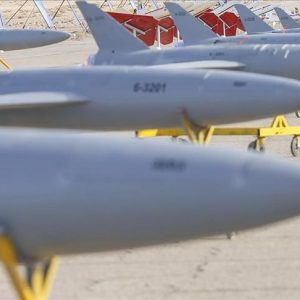
Iran has launched waves of attacks on countries hosting U.S. forces. Italy’s military said a drone strike at Ali Al Salem airbase in Kuwait destroyed an Italian unmanned aircraft but caused no casualties — the second hit on an Italian base in the region this week. Italian Foreign Minister Antonio Tajani played down the incident, insisting “We are not at war with anyone.”
Iraqi authorities said rockets wounded five people at Baghdad’s airport, which houses a US diplomatic facility, while Iran’s Revolutionary Guards claimed around 700 missiles and 3,600 drones had been fired at U.S. and Israeli targets so far.
French President Emmanuel Macron told Iran’s President Masoud Pezeshkian it was “unacceptable” to target French interests after an Iranian-designed drone killed a French soldier in Iraq’s Kurdistan region.
At Dubai’s airport — previously one of the world’s busiest — flights were temporarily suspended after a drone-related incident sparked a fire that damaged a fuel tank. Authorities said the blaze was extinguished with no injuries reported.
Israeli military spokesman Brigadier General Effie Defrin said the country still has “thousands of targets in Iran, and we are identifying new targets every day.”


Read also


