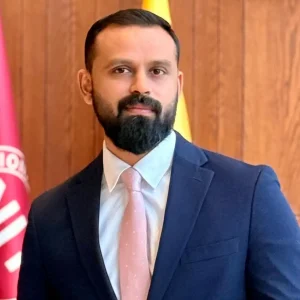
Pakistan’s Al-Khidmat navigates siege to deliver aid in genocide-hit Gaza
Pakistan’s Al-Khidmat Foundation says it has employed “out-of-the-box” strategies to keep relief flowing into Gaza
© AA
By Muhammad Akhtar Pathan
ISLAMABAD, Pakistan (MNTV) — As Gaza suffers the world’s worst manmade humanitarian catastrophe, Pakistan’s Al-Khidmat Foundation – one of the major relief organizations working in the war-ravaged land – says it has employed “out-of-the-box” strategies to keep relief flowing into the besieged territory.
“Gaza – with over 70,000 people, mostly women and children, killed and more than 170,000 wounded since October 2023 in relentless Israeli airstrikes, ground attack and enforced starvation – is without a doubt the biggest humanitarian crisis in the world,” said Syed Waqqas Jafri, secretary general of Al-Khidmat Foundation Pakistan.
“The destruction is overwhelming, and the continued Israeli siege of the territory has made the delivery of relief goods an unprecedented challenge.”
Jafri said the organization quickly partnered with welfare groups already operating inside Gaza — including those from Turkiye — and mobilized its international network to circumvent supply blockages.
Al-Khidmat also coordinated a joint action plan with the Pakistani government, NGOs, the Egyptian Red Crescent and Pakistani embassies in Egypt, Lebanon and Jordan to push aid through the region’s few remaining access points.
Senior Al-Khidmat leaders, including its president and secretary general, traveled repeatedly to these countries to oversee operations. The foundation set up a camp office and warehouse in Egypt and created a system to move supplies through the Rafah border whenever possible.
According to Jafri, the organization received “full support” from the government of Pakistan, the National Disaster Management Authority and the Ministry of Foreign Affairs, as well as from Pakistani embassies abroad.
Jafri said Gaza’s most urgent needs remain cooked food, clean drinking water and emergency medical care.
Other critical gaps include temporary shelter for more than two million displaced people, hygiene kits for women, milk for children, support for orphans, restoration of education and basic infrastructure.
Al-Khidmat, he said, has been providing cooked meals, potable water, medical assistance, hygiene kits, milk for children, tent schools, orphan sponsorships, scholarships for Palestinian youth to study in Pakistan, and tents and tarpaulins for temporary shelter. The foundation estimates its relief work has exceeded PKR 8 billion so far.
When the first brief ceasefire opened limited humanitarian access in November 2023, Al-Khidmat moved quickly to prepare for its possible collapse. It recruited a team of local Palestinian volunteers, established a kitchen inside Gaza and stockpiled supplies.
When the ceasefire ended in January 2024, the volunteer network continued daily distribution of cooked meals and clean water — a program that Jafri says is still running.
‘Almost 100 percent destroyed’
While food and shelter remain urgent, Jafri said the destruction in Gaza goes far beyond immediate survival.
“The health, education and water systems and infrastructure across the entire Gaza Strip have been almost 100 percent destroyed,” he said. “Millions of tons of rubble remain. Thousands of children are orphans. Millions have lost access to education. Many of the injured urgently need to be taken abroad for treatment.”
He said the need for long-term rehabilitation prompted Al-Khidmat to launch a PKR 15 billion “Gaza Restoration” campaign immediately after the ceasefire.
The initiative includes rubble removal, construction of a major hospital on the Gaza border, transport of 3,000 injured Palestinians to Pakistan for treatment, sponsorship of 2,250 additional orphans, 600 scholarships for higher education in Pakistan, establishment of five temporary schools in Gaza and completion of 100 clean water projects, he said.
Despite the emphasis on reconstruction, daily relief distributions continue inside Gaza, he said, with Palestinian volunteers providing food and water and incoming aid shipments routed through Pakistan, Egypt and other countries.
Donors and volunteers
Jafri said Al-Khidmat considers all its donors equally important, whether their contributions are modest or substantial, though most long-term programs — including orphan sponsorship — depend on regular monthly donors.
He emphasized that the organization’s leadership works voluntarily, supported by a nationwide network of more than 68,000 volunteers. Paid staff also play an essential role in project implementation, he said.
“The success and performance of Al-Khidmat depend equally on those who volunteer and those who work under compensation,” he said. Field operations rely heavily on volunteers, while technical and administrative completion of projects rests with paid staff.
A culture of selfless service
Jafri said his experience has shown that Pakistanis “have a greater passion for working for the sake of Allah than any other nation.” He credited the foundation’s 35-year history to a growing culture of volunteerism, especially among youth.
Finding and guiding such individuals, he said, is a “major responsibility” for both institutions and society.
Al-Khidmat has expanded its outreach to young people through a wide range of programs, culminating in a new Volunteer Management System that has registered millions nationwide.
“With each passing day, the passion for serving humanity is increasing,” he said. “This is why we now have the largest volunteer network in Pakistan.”
Related posts

Read also