4 days ago
Dispute erupts over Muslim contractor for temple work in India
A routine infrastructure contract in Uttar Pradesh sparks protests, highlighting how religious identity increasingly shapes Muslim access to public work in India
© File Photo
NEW DELHI, India (MNTV) — In Uttar Pradesh, India’s most populous state and a central laboratory of Hindu majoritarian politics, a routine infrastructure contract at a major Hindu shrine has escalated into a communal controversy, underscoring how Muslim participation in public life is increasingly contested.
The dispute centers on the Thakur Banke Bihari Temple in Mathura, one of Hinduism’s most visited pilgrimage sites. A Muslim-linked construction firm was awarded a contract to install steel railings to regulate crowd movement inside the temple complex — a standard safety measure ahead of peak pilgrimage periods.
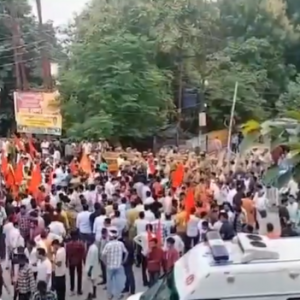
The issue gained traction after the contractor’s identity became public, triggering protests by right-wing Hindu groups who objected to a Muslim entity carrying out work connected to a temple. Videos circulating online show activists questioning the legitimacy of a Muslim contractor’s presence in a religious space, with demands framed explicitly around faith rather than procedure or performance.
The controversy was amplified by social media influencers aligned with Hindu nationalist narratives, who compared the contract to restrictions imposed on Muslims at other religious sites, effectively arguing that religious identity should determine access to economic opportunity. While allegations were raised about political influence in the tendering process, no evidence has been presented to support those claims.
Temple authorities rejected the communal framing, stating that the contract was awarded through established procedures and that religion plays no role in procurement decisions. Members of the temple’s management committee stressed that the work concerns public safety and crowd control, not religious practice.
The episode has reignited a wider debate in India over how Muslims are increasingly excluded from ordinary commercial activity, particularly when work intersects with Hindu religious spaces.
Analysts note that such disputes reflect a broader ideological shift in which economic participation is being filtered through religious identity, normalizing discrimination even when no law is violated.
Civil rights advocates say the Mathura incident is part of a growing pattern under India’s current political climate, where Muslims face informal bans, boycotts, and public hostility in sectors ranging from housing and street vending to construction and transport.


Read also