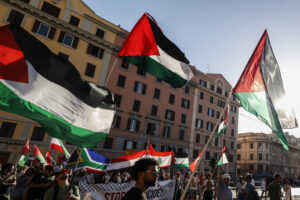
Algerian authorities ban pro-Palestine protest, reigniting constitutional debate
Opposition parties criticize government for blocking Algiers march, citing constitutional guarantees on peaceful assembly
© File Photo
ALGIERS, Algeria (MNTV) – Algerian authorities have rejected a request by a coalition of opposition parties to hold a pro-Palestine demonstration in Algiers, citing concerns over public order—a move that has drawn criticism and revived long-standing concerns over the country’s protest restrictions.
The Interior Ministry denied permission for the planned march, which was scheduled for August 7 or 8 under the banner “Algeria with Palestine, against starvation and displacement.”
The request had been submitted on July 29 by a coalition of 12 political parties, in what would have marked the first large-scale pro-Palestinian protest since October 2023.
Instead, authorities advised organizers to hold the gathering indoors, referencing Law 89-28—a 1989 statute governing public assemblies, which permits banning events deemed disruptive to “national values or public order.” No specific justification was given for why the protest would pose such a threat.
The decision comes despite the 2020 Algerian constitution guaranteeing the right to peaceful assembly, though it stipulates this must be carried out “according to conditions set by law.”
In 2021, those conditions were tightened to require prior notification and a full list of organizers—criteria the opposition claims were met.
“This isn’t just about Gaza. It’s about whether the Algerian state respects its own constitution,” said Abdellouahab Yagoubi, a lawmaker from the opposition Movement of Society for Peace, calling the move a clear violation of Article 52.
He also urged the repeal of the decades-old protest law, which he said is incompatible with the post-Hirak legal framework.
The protest ban comes amid what rights groups and observers describe as a shrinking civic space in Algeria. Since 2021, authorities have intensified crackdowns on journalists, activists, and citizens over online expression and participation in peaceful demonstrations.
Political analyst Mohamed Boudiaf suggested that the government fears pro-Palestine mobilisations could evolve into wider anti-government protests, as seen during the 2019 uprising that led to the ousting of President Abdelaziz Bouteflika.
During those mass demonstrations, chants in support of Palestine and against military rule echoed through the streets—often originating from football stadiums, long seen as informal arenas for political dissent.
In the broader North African context, public support for the Palestinian cause has frequently intersected with domestic demands for political reform. In countries like Morocco and Tunisia, pro-Gaza rallies have also become platforms for challenging local government policies.
Last May, a coalition of Algerian political parties urged the state to lift restrictions on such demonstrations.
“It is incomprehensible for the authorities to continue to ban marches and demonstrations in support of the Palestinian cause, which is our central issue,” said Louisa Hanoune, head of the Workers’ Party.
While Algeria has consistently opposed normalisation with Israel and has condemned Israeli actions in Gaza, critics argue that its external rhetoric is undermined by its internal policies suppressing free expression and assembly.
Despite the ban, opposition parties continue to call for public expression of solidarity with Palestine.
Related posts


Read also