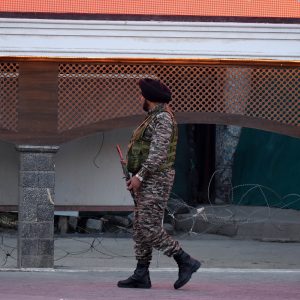
Pakistan’s Sindh observes Kashmir Black Day with province-wide rallies
Civil society, educators, and activists in Sindh express deep affinity with Kashmir’s struggle, calling it a shared experience of resistance against oppression
© File Photo
Safeer Raza
KARACHI, Pakistan (MNTV) — Cities and towns across Pakistan’s province, Sindh, marked Kashmir Black Day on Monday with rallies, seminars, and public events in schools, colleges, and government offices to denounce India’s control of Jammu and Kashmir and express solidarity with the Kashmiri people’s demand for self-determination.
Around the world, Kashmiris observe October 27 each year as the day Indian troops landed in Srinagar in 1947 and took control of the territory.
In Karachi, the Sindh government led a large Kashmir Solidarity Rally from the People’s Secretariat to Mazar-e-Quaid, headed by Minister for Local Government and HTP Department Syed Nasir Hussain Shah.
The event drew participation from provincial ministers, secretaries, All Parties Hurriyat Conference (APHC) leaders, and members of civil society. Participants carried banners and placards with slogans condemning India’s continued military presence in the disputed region and calling for the implementation of United Nations resolutions on Kashmir.
Addressing the rally, Nasir Hussain Shah described October 27 as “the darkest day in South Asian history,” marking the beginning of India’s illegal occupation of Jammu and Kashmir in 1947. He said sustainable peace in the region would remain unattainable without resolving the dispute in accordance with the wishes of the Kashmiri people.
Across Sindh, similar events were held in towns including Hyderabad, Sukkur, Larkana, and Mehrabpur, where local schools and civic groups organized marches and discussions in solidarity with Kashmiris.
In Mehrabpur, Mohammad Mithal, principal of a private school, led a student rally and said the Kashmir cause resonates deeply among Sindhis of all social backgrounds. “Kashmir is a central issue for Sindhis across all social classes. We and Kashmiris share the exploitative conditions imposed by our respective rulers,” he told MNTV.
“From Kashmir’s history of persecution and resistance, we learn perseverance. In our curriculum, students are encouraged to study and idealize the Kashmiris’ struggle against occupation and injustice.”
Talking to MNTV, Sindhi nationalist activist Saeed Khan drew parallels between the two regions, saying both Sindh and Kashmir face systemic oppression. “Sindhis, like Kashmiris, are occupied by their ruling elites — the local feudal chiefs, or waderas,” he said.
“In both cases, we are persecuted by structures of exploitation. India has plundered Kashmir’s natural resources and tied its economy to New Delhi’s administrative control. Similarly, the Pakistani state has extracted Sindh’s wealth and continues to do so. The only difference lies in the faces of the oppressors, not in their methods.”
Marxist activist Sufi Laghari also condemned India’s policies in Kashmir, calling the country “an occupying power with imperial ambitions.” He warned that India seeks to create divisions among Pakistan’s diverse ethnic groups as part of a broader geopolitical strategy. “India has acted as an imperial state since its inception,” he said. “Those Sindhi commentators who romanticize India as an ancient neighbor fail to see its colonial behavior. For both Kashmiris and Sindhis, India represents a shared threat — a power that claims a right over the entire South Asian region.”
Participants across the province emphasized that the people of Sindh have historically stood with the Kashmiri cause, driven by shared experiences of marginalization and resistance. “People in Sindh have always supported the Kashmiri movement with heart and mind,” said one participant. “We see our own exploitation reflected in the Kashmiris’ struggle. The oppressors may differ, but their methods remain the same.”
Several speakers recalled the tradition of holding pro-Kashmir rallies in Sindhi schools since childhood, describing it as a formative part of civic awareness. “Those events made us realize how intertwined our histories are — bound by a common culture, religion, and emotional solidarity,” said a participant.
The day’s observances concluded with renewed pledges from Sindh’s officials, activists, and educators to continue raising their voices for Kashmir at national and international forums until the Kashmiri people achieve their inalienable right to freedom.

Read also