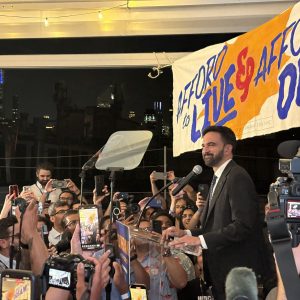
Mamdani’s Mayoral Run: Fight for New York’s Future
NYC mayor-elect openly supports Palestinian rights, challenges long-standing power structures that have shaped US politics for decades
NEW YORK, United States (MNTV) – The election of Zohran Mamdani as New York City’s mayor marks a turning point in American urban politics, signaling a growing readiness among voters to challenge entrenched political power and traditional foreign policy norms.
Mamdani, a Muslim democratic socialist who has openly championed Palestinian rights, won decisively in a race that upends decades of conventional alliances and political influence. His victory represents not just a local political shift but a broader realignment in how American voters, particularly in major cities, view both domestic and international issues.
The mayor-elect’s campaign broke with the long-standing influence of pro-Israel lobbying groups in US elections.
By pairing progressive domestic policies with outspoken criticism of Israeli actions in Gaza, Mamdani proved that candidates can prevail without aligning with Washington’s traditional foreign policy positions—a pattern that has defined mainstream American politics since the mid-20th century.
His grassroots campaign drew strong support from Muslim, immigrant, young, and working-class communities, overcoming financial disadvantages against better-funded rivals.
Emphasizing small-donor contributions and local organizing, the movement behind Mamdani showed how people-powered campaigns can compete with well-established political machines.
Analysts say his success highlights a growing public awareness of international issues through digital media and suggests that voters increasingly evaluate candidates based on their stance toward global justice and human rights.
While Mamdani now faces major challenges in tackling New York’s housing, inequality, and policing issues, his victory underscores a deeper political transformation.
It reflects the emergence of new coalitions and ideological realignments reshaping Western democracies—and could carry implications for global observers, including nations like Turkey, that closely follow shifts in US political currents.

Mumbai BJP chief calls Mamdani’s win “vote jihad,” vows to block any ‘Khan’ from leading the city as Islamophobia crosses borders
NEW DELHI, India (MNTV) — A senior politician from India’s ruling Bharatiya Janata Party (BJP) has drawn widespread condemnation after reacting to Zohran Mamdani’s historic election as New York City’s first Muslim mayor with an Islamophobic remark, declaring, “We will not allow any Khan to become mayor.”
The surname “Khan” is widely used among Muslims in South Asia, particularly in India, Pakistan, and Bangladesh. In India’s polarized political climate, Hindu nationalist leaders often use it as shorthand for Muslim identity—turning a common name into a communal slur.
The remark came from Ameet Satam, the BJP’s Mumbai president and a lawmaker from Andheri West, who described Mamdani’s victory as a case of “vote jihad.”
The term “vote jihad” is a Hindutva conspiracy theory that alleges Muslims use their voting power to undermine Hindu interests—an idea regularly promoted by India’s right-wing ecosystem to stoke fear and polarization during elections.
Mamdani, a Democratic socialist and the first South Asian to lead New York City, defeated former governor Andrew Cuomo in a landmark U.S. election this week. He had previously drawn the ire of India’s Hindu nationalist circles after calling Prime Minister Narendra Modi a “war criminal” and comparing him to Israel’s Benjamin Netanyahu, citing their roles in state-sponsored violence.
Satam claimed “international cities are changing colours” and warned that “if someone tries to impose a Khan on Mumbai, it will not be tolerated.” His post, shared widely by right-wing accounts, drew backlash for importing Islamophobic narratives from India’s domestic politics into a global context.
Opposition leaders in Maharashtra condemned Satam’s comments as hate-filled and dangerous. Anish Gawande of the Nationalist Congress Party (NCP) reminded him that Muslim generals such as Siddi Ibrahim Khan and Daulat Khan fought alongside Maratha ruler Shivaji, accusing the BJP of betraying Maharashtra’s plural legacy.
Congress leader Sachin Sawant said the BJP was attempting to “divert public attention from its failures” in Mumbai, where urban decay, flooding, and corruption have worsened under its rule. “People aren’t living, they’re just surviving,” he said, accusing the party of injecting communal politics ahead of upcoming local elections.
Satam has previously made similar remarks, warning that “international countries are being infiltrated”.
In September, at a BJP event attended by top state leaders, he cautioned that “tomorrow, a Bangladeshi could be on the doorstep of Mumbaikars.”
The controversy has drawn parallels between Islamophobia in India and the United States, as Mamdani himself faced relentless attacks from far-right figures during his mayoral campaign.
Opponents and conservative media labeled him a “jihadist” or “terrorist sympathizer” and repeatedly invoked 9/11; in one radio interview, Andrew Cuomo laughed along when a host suggested Mamdani would “cheer another 9/11”.
In his victory speech, Mamdani — the youngest New York mayor in a century — addressed these attacks head-on. “I am young. I am Muslim. I am a democratic socialist. And most damning of all, I refuse to apologize for any of this,” he told cheering supporters.
Observers say the episode underscores how anti-Muslim rhetoric has become a shared language among right-wing movements across continents, uniting ideologies that demonize Muslim representation whether in New York or Mumbai.
New York City mayor-elect Zohran Mamdani said he remains open to speaking with US President Donald Trump about ways to cooperate
NEW YORK CITY, United States (MNTV) – New York City mayor-elect Zohran Mamdani said he remains open to speaking with US President Donald Trump about ways to cooperate for the city’s benefit but made clear he would reject any proposal that harms residents.
“I’m open to a conversation about delivering on the priorities that New Yorkers have raised, including tackling the cost of living,” Mamdani said, adding that he has yet to receive congratulations from the White House. “Any engagement that comes at the expense of New Yorkers, I will fight tooth and nail—my job is to serve this city.”
The mayor-elect said the real source of Republican opposition to his platform lies in its potential to succeed. “What scares Republicans across the country is that we will actually deliver on this agenda, and the contrast is something they cannot bear to witness,” he said.
Mamdani also emphasized his commitment to combating anti-Semitism, pledging that his administration “will stand steadfast with Jewish New Yorkers in fighting the scourge of anti-Semitism across the city.” He said he aims to work closely with communities “to protect, celebrate, and cherish Jewish life across New York.”
Reaffirming his belief in the rule of law, Mamdani told reporters that “all people will be held to the same standard of the law,” pledging to usher in “an era of consistency, clarity, and conviction” in city governance.
On the transition process, Mamdani said he looks forward to collaborating with outgoing Mayor Eric Adams for a smooth handover.
He named Ilana Leopold as transition director and announced an all-female team of co-chairs: former Federal Trade Commission Chair Lina Khan, former First Deputy Mayor Maria Torres-Springer, United Way CEO Grace Bonilla, and former Deputy Mayor for Health and Human Services Melanie Hartzog.
Far-right commentators and politicians unleash attacks on the city’s first Muslim mayor-elect
NEW YORK (MNTV) — Within hours of Zohran Mamdani’s historic election as New York City’s mayor, a torrent of Islamophobic rhetoric swept across social media and conservative media circles, turning the victory of the city’s first Muslim mayor-elect into a new front in America’s culture wars.
Posts, statements, and televised commentary followed a familiar script, questioning Mamdani’s loyalty, his citizenship, and even his faith. Some Republican lawmakers called for a review of his naturalization, while others hinted that his progressive platform signaled “foreign sympathies.”
CNN’s Van Jones was among those raising ‘alarm’ at Mamdani’s instant ‘character switch’ after winning power. In a doubtful language, Jones pointed out Mamdani’s ‘sudden shift’ and called for suspicion to judge his character, explicitly presenting his unreasoned Islamophobia.
President Donald Trump led the backlash, calling Mamdani a “communist lunatic backed by Islamist donors” during a rally in Florida. Senator Ted Cruz echoed the line, writing on X that “the Crown Jewel of America is now governed by a communist jihadist.”
Conservative commentator Ben Shapiro warned that “Mamdani wins a blowout victory, and announces the advent of a communist-Islamist future.” The framing, part Cold War panic, part post-9/11 paranoia, quickly shaped coverage across right-wing networks.
Far-right commentator and an important part of Trump's new administration, Laura Loomer went further, demanding that “Trump dismantle Mamdani and his entire Islamic network by denigrating the Muslim Brotherhood as a terrorist organization and filing charges against the Islamic groups and 501c3s that funded Mamdani’s campaign.”
The 501(c)(3) is a specific legal designation under the U.S. Internal Revenue Code that grants federal income tax-exempt status to organizations operating exclusively for certain public-benefit purposes.
In all caps, she added: “TAKE AWAY THE 501c3 STATUS OF THE 4-LETTER ISLAMIC TERROR ‘NON-PROFITS’ THAT FUND MAMDANI.”
Israeli commentator Eval Yakoby accused Mamdani of celebrating his win alongside “pro-Hamas agitators and jihadist mouthpieces,” naming individuals such as Hasan Piker and Mehdi Hasan, claims that were unsubstantiated but widely shared by pro-Israel and far-right accounts.
Real-world threats matched the digital fury. Authorities confirmed an arrest after a man left a series of menacing voicemails directed at Mamdani and his family, underscoring how online hostility has spilled into physical intimidation.
Some conservative outlets framed Mamdani’s campaign as part of an “Islamic influence machine” seeking to infiltrate American politics, recycling conspiracy theories that have circulated since the early 2000s.
Others revived discredited narratives linking Muslim political organizing to extremism abroad.
Several Jewish and pro-Israel organizations expressed unease, citing Mamdani’s outspoken criticism of Israeli policies in Gaza. Many declined to issue the customary congratulations, while others offered cautious statements emphasizing dialogue on antisemitism and public safety.
The atmosphere around Mamdani’s win illustrates how identity politics, religion, and ideology can converge into a potent backlash. For many of his supporters, the post-election uproar is less about policy and more about the discomfort of a political establishment confronting a new kind of leadership — young, Muslim, and unapologetically progressive.
As the city transitions toward Mamdani’s administration, the question is no longer whether he can govern, but whether New York — and America’s political class — can rise above the prejudice that his victory has laid bare.
From London to Bogotá, left-wing politicians celebrate New York’s first Muslim, South Asian mayor as a symbol of hope against global populism
NEW YORK, United States (MNTV) – The election of Zohran Mamdani as New York City’s first Muslim and South Asian mayor has sparked an outpouring of support from progressive politicians and movements around the world. Many have described the 34-year-old’s victory as a moment of renewal for liberal and left-wing politics amid the global rise of right-wing populism.
In Britain, political figures across the Labour and Green parties praised Mamdani’s grassroots campaign and vision for economic justice.
London Mayor Sadiq Khan, who has also faced Islamophobic attacks from former US President Donald Trump, called Mamdani’s win “a victory for hope.” Writing in Time magazine, Khan said, “Doubters have long predicted the decline of London and New York.
But each time we’ve faced a crisis of confidence, we’ve emerged stronger than before.”
Former Labour leader Jeremy Corbyn, who campaigned for Mamdani in New York days before the vote, hailed the outcome as “a seismic victory” for people “who believe humanity and hope can prevail.”
Other British lawmakers from Labour’s left wing, including Clive Lewis, Luke Charters, and Uma Kumaran, said Mamdani’s win offered “lessons for Labour,” showing that courage, conviction, and community organizing can defeat fear and cynicism.
Green Party leader Zack Polanski said he admired Mamdani’s “relentless focus on inequality,” while independent MP Zarah Sultana described the win as “the politics of hope over hate.”
Voices from Europe and beyond
In Europe, the reaction was equally enthusiastic. Manon Aubry, co-chair of the Left group in the European Parliament, congratulated Mamdani for overcoming “the media, economic, and political establishment that spent tens of millions of dollars to block his path,” praising his refusal to stay silent on racism and Gaza.
Aubry and other European progressives from Germany and France had visited New York last week to study Mamdani’s campaign as a model for future elections.
Budapest’s liberal mayor Gergely Karácsony, a vocal critic of Hungary’s far-right leader Viktor Orbán, called Mamdani’s victory “a reminder that democracy can still function.”
He praised the New Yorker for standing up to both Trump and establishment elites, saying his policies “serve the majority, not the privileged.”
In the Middle East, Israeli Arab lawmaker Ayman Odeh of the Hadash-Ta’al party said Mamdani’s rise was “a remarkable reflection of human progress,” noting that a Muslim winning New York’s mayorship would have been unthinkable after 9/11.
He said Mamdani’s success offered “hope for the kind of moral change that can bring peace to our region.”
Left-party lawmakers in Germany celebrated the result as a victory for solidarity and human rights, and called on leaders to take a clear stance on issues such as the genocide in Gaza.
Left Party lawmaker Nicole Gohlke said Mamdani’s success was “not just a local success — a symbol that the idea of a society based on solidarity can be successful, even in the heart of capitalism,” and praised his stance on human rights.
Latin America’s left joins in celebration
Colombia’s President Gustavo Petro shared a photo with Mamdani, while his party colleague María José Pizarro Rodríguez wrote that the win proved “liberal ideas are not radical—they’re necessary.”
In Canada, former New Democratic Party leader Jagmeet Singh said Mamdani’s victory showed that “when the odds feel stacked against working people, change is still possible.” Fellow NDP MP Heather McPherson added that his campaign demonstrated “change starts with us.”
Even in India, opposition figures expressed admiration. Congress Party leader Abhishek Manu Singhvi said the victory showed “youth, energy, and dynamism matter,” proving that liberal values can still thrive in the Trump era.
As messages of support continued to pour in, many of Mamdani’s international admirers agreed on one thing: his victory has reenergized progressive movements worldwide, offering a rare moment of optimism in an age of division and political disillusionment.
Trump has said he is willing to assist New York Mayor-elect Zohran Mamdani but cautioned that the new leader must be “respectful”
WASHINGTON, United States (MNTV) – US President Donald Trump has said he is willing to assist New York Mayor-elect Zohran Mamdani but cautioned that the new leader must be “respectful” toward Washington to succeed.
Trump made the comments on Wednesday, a day after Mamdani unveiled his transition team following his historic victory as New York City’s first Muslim and South Asian mayor.
Responding to Mamdani’s vow to “stand up to Trump” in his victory speech, the president told Fox News’ Bret Baier that the mayor-elect’s words were a “dangerous statement.”
“He has to be a little bit respectful of Washington, because if he’s not, he doesn’t have a chance of succeeding,” Trump said. “And I want to make him succeed. I want to make the city succeed.”
Trump then clarified that he wanted New York City, not necessarily Mamdani, to succeed.
Earlier in the day, while addressing the American Business Forum in Miami, Trump again criticized Mamdani, calling him a “communist,” but added that his administration would “help him a little bit.”
“The communists, Marxists, and globalists had their chance, and they delivered nothing but disaster,” Trump said. “Now let’s see how a communist does in New York. We’ll help him, we’ll help him. We want New York to be successful.”
During the campaign, Trump had frequently attacked Mamdani, labeling him a “communist lunatic” and threatening to cut federal funding if he won.
Mamdani, a self-described democratic socialist, has dismissed Trump’s accusations, saying his agenda—free universal childcare, free public buses, and government-run grocery stores—aims to improve equity, not impose communism.
His victory has been hailed as a major moment for progressives within the Democratic Party, which continues to struggle between its centrist and left-leaning factions.
In his victory address, Mamdani called his campaign a model for defeating Trumpism, urging the president to “turn the volume up.”
On Wednesday, he reiterated both his opposition to Trump’s policies and his openness to dialogue.
“I will not mince my words when it comes to President Trump,” Mamdani said. “I will continue to describe his actions as they are, while leaving a door open to have that conversation.”
Exit poll shows deep political and cultural divides within New York’s Jewish community, as younger progressive Jews backed Zohran Mamdani while Orthodox neighborhoods turned out overwhelmingly for Andrew Cuomo
NEW YORK (MNTV) — A CNN exit poll has revealed striking divisions within New York City’s Jewish electorate during this year’s mayoral race.
While about one-third of Jewish voters supported Zohran Mamdani, the progressive Queens assemblyman and self-described democratic socialist, nearly two-thirds backed former Governor Andrew Cuomo, the independent centrist who dominated Orthodox and more conservative enclaves across the city.
According to CNN, 33% of Jewish respondents voted for Mamdani, 63% for Cuomo, and only 3% for Republican Curtis Sliwa. The poll’s Jewish sample included roughly 710 voters, though the network did not release details about its methodology or margin of error.
Because New York City does not record voters’ religion or ethnicity, analysts rely on geographic data to interpret voting patterns. That data shows a clear religious and generational split.
In Hasidic and Orthodox neighborhoods such as Williamsburg, Crown Heights, and Boro Park, Cuomo captured overwhelming majorities — often above 90%. In one Boro Park precinct, he secured more than 96% of the vote, making it his single strongest area in the city.
These communities, which tend to prioritize public safety, religious education funding, and close relations with city authorities, have long maintained close ties with establishment figures like Cuomo.
Community leaders reportedly viewed Mamdani’s criticism of Israeli crimes and calls to redirect police funding with suspicion, helping consolidate the Orthodox vote behind Cuomo.
But just a few blocks away, in gentrified corners of Brooklyn and Queens, Mamdani found robust support. Neighborhoods such as Astoria, Long Island City, Greenpoint, and parts of Park Slope voted for him in landslide numbers, often exceeding 80%.
Many younger and secular Jewish voters in these areas were drawn to Mamdani’s message of social justice, affordable housing, and opposition to corporate influence in politics.
Cuomo also performed strongly in affluent Manhattan precincts, especially on the Upper East Side and parts of the Upper West Side. Both areas include large but diverse Jewish populations — blending older liberal voters with younger professionals — yet the former governor’s appeal to moderation and experience won out.
Political observers say the results reflect broader cultural fault lines within American Jewry. “The Jewish vote in New York is not monolithic,” said Sarah Klein, a senior analyst at the Gotham Institute for Civic Studies.
“Younger Jews are far more likely to identify with progressive movements and question traditional party loyalties, while Orthodox voters remain deeply pragmatic and loyal to leaders who protect their communal interests.”
The 2025 election results have thus underscored how New York’s Jewish community — once considered a cohesive voting bloc — now mirrors the city’s wider ideological polarization. As Mamdani’s movement reshapes local politics, the contest for Jewish voters’ future allegiance may prove to be one of the defining stories of the city’s next political era.
Zohran Mamdani’s victory in the New York City mayoral race upended conventional wisdom — proving that a public movement can overcome tens of millions in establishment money
MNTV Staff Writer
NEW YORK (MNTV) — Zohran Mamdani’s landslide win over Andrew Cuomo has redrawn the map of political power in America’s largest city.
Despite being massively outspent, the 34-year-old Queens assemblyman defeated the former governor and his billionaire-funded campaign machine, signaling a deep shift in how New Yorkers engage with politics.
Financial disclosures show Cuomo’s side — including his official campaign and allied super PACs — spent an estimated $56 million during the election, compared to just under $17 million for Mamdani.
Of Mamdani’s total, nearly $13 million came from public matching funds, part of the city’s program designed to amplify small donors. The rest came from nearly 170,000 contributions averaging under $100 each, a record for any municipal race in New York City history.
Cuomo, by contrast, leaned heavily on corporate and high-net-worth donors. Hedge fund executives, real estate developers, and venture capitalists formed the backbone of his financial network.
Records from the city’s Campaign Finance Board show that 94 percent of donations from finance-sector professionals went to Cuomo, including large checks from Blackstone, Citadel, and JPMorgan executives.
Among the most prominent backers were billionaire developers Stephen Ross and Daniel Loeb, who contributed through political committees. Ross’s New York Forward PAC alone donated $3.2 million to pro-Cuomo groups. Former Mayor Michael Bloomberg made a personal contribution of $1.5 million to Fix The City — the largest super PAC supporting Cuomo — just a week before polls closed.
Fix The City emerged as the single biggest outside spender in the race, investing $28 million in television, digital, and mail advertising. Another group, Defend NYC, added $14 million, much of it on attack ads accusing Mamdani of being “soft on crime” and “anti-police.”
In total, outside spending favoring Cuomo or attacking Mamdani reached $50.8 million, more than seven times the amount of independent expenditures supporting Mamdani.
Mamdani’s campaign itself spent frugally but strategically. The team focused its $17 million war chest on grassroots organizing, digital outreach, and multilingual voter engagement. Volunteers knocked on nearly 1.2 million doors across the five boroughs. Campaign manager Leila Rahman said, “We didn’t have Wall Street. We had WhatsApp groups, Metro cards, and block captains.”
Cuomo’s campaign, meanwhile, spent lavishly on media buys and consultants. Advertising accounted for nearly $33 million, including a saturation blitz across major networks and streaming platforms in the final ten days.
Yet despite the financial advantage, his message failed to connect with younger and working-class voters frustrated by years of inequality and establishment politics.
Cuomo’s campaign was also fined $1.3 million for alleged coordination with Fix The City, a violation of city campaign finance rules. The penalty came after leaked emails suggested joint planning of ad schedules and talking points — an issue that further dented Cuomo’s credibility.
Political analysts say the result is a watershed moment.
“This race shattered the myth that you can buy your way into City Hall,” said Columbia University’s Professor Marcia Geller. “Mamdani showed that small donors, volunteers, and social networks can defeat moneyed interests if the message resonates.”
In neighborhoods from Queensbridge to the South Bronx, turnout was the highest since 1969, with young voters leading the surge. For Mamdani, the victory was about more than politics. “We didn’t just win an election,” he said on election night. “We proved that in New York City, power still belongs to the people — not to the billionaires.”
In a city long dominated by money and influence, the election of Zohran Mamdani stands as a rare story of people’s power triumphing over political fortune.
Historic New York mayoral win seen as turning point for South Asian representation ahead of 2026 and 2028 elections
NEW YORK (MNTV) — Zohran Mamdani’s election as New York City’s first Muslim and South Asian mayor has sparked renewed optimism across the South Asian-American community, long under-represented in U.S. politics but increasingly active in local and state races.
Mamdani, 34, defeating former Governor Andrew Cuomo and Republican Curtis Sliwa, marks a generational and demographic shift, according to political observers.
His campaign emphasized affordability, social services and immigrant rights — themes which resonated strongly within diverse urban communities.
For many in the South Asian diaspora, the victory goes beyond symbolism. According to a 2023 Pew Research study, South Asians now number over 5 million in the U.S., making them one of the fastest-growing ethnic groups with rising electoral significance in key states like New York, New Jersey and California.
Local organizing was a significant factor in the campaign. South Asian-led groups reported high engagement: volunteers canvassed in Queens, Brooklyn and Staten Island, and younger campaigners played major roles in digital outreach and voter mobilization.
Nationally, Mamdani’s win is already resonating. In a statement, Muslim advocacy group, Council on American‑Islamic Relations (CAIR) described the outcome as “a historic turning point for Muslim Americans” and commended the youth and immigrant voters who supported him.
“This recommits our community to civic engagement and shows what is possible when young people organize,” CAIR added.
As South Asian-American candidates seek higher offices — from U.S. House seats to statewide offices — analysts say Mamdani’s victory could reshape how the community approaches elections: less as a minority interest bloc and more as a driving force for issue-based, coalition politics.
With the 2026 midterms and the 2028 presidential cycle looming, the mayor-elect’s progressive platform — including proposals for universal childcare, rent freezes and public transit expansion — is seen by many as a template for future campaigns.
The broader political implication: urban America may increasingly turn to candidates who reflect both identity and progressive policy commitments. For immigrant communities in New York, Mamdani’s victory is more than a milestone — it’s a sign of deeper integration into the civic mainstream.
CAIR and Shia Muslim Foundation call victory a milestone for representation, and social justice, and a rejection of Islamophobia and anti-Palestinian racism in politics
NEW YORK CITY (MNTV) — Muslim groups across the United States have celebrated Zohran Mamdani’s election as New York City’s first Muslim and South Asian mayor, calling it a defining moment for representation and a rejection of Islamophobia in American politics.
The Council on American-Islamic Relations (CAIR) said Mamdani’s victory signaled a “historic turning point” for Muslim Americans, especially after a campaign marked by anti-Muslim attacks.
“Mayor-elect Mamdani’s ability to win while openly advocating for Palestinian human rights and enduring a barrage of anti-Muslim hate marks a historic rebuke of both Islamophobia and anti-Palestinian racism in politics,” CAIR said in a statement.
The advocacy group also praised young voters, especially university students, for mobilizing in support of Mamdani’s progressive campaign.
“Just one year after being smeared and brutalized for protesting the genocide in Gaza, these young people helped elect a mayor who vocally opposes that genocide and supports the right to peaceful protest,” it added.
Echoing similar sentiments, the Washington-based Shia Muslim Foundation (SMF) congratulated Mamdani for what it described as a “powerful and inspiring moment” for American Muslims and the broader Shia community.
“Zohran Mamdani’s election shows that when our community engages, organizes, and votes, we secure the representation needed to advance our shared values for housing, equity, and dignity,” said Rahat Husain, SMF’s Executive Director.
The Foundation highlighted that Mamdani’s campaign — centered on economic justice — resonated strongly with New Yorkers. His platform includes universal childcare, rent freezes for stabilized housing, free city buses, and construction of 200,000 affordable housing units, financed by higher taxes on corporations and millionaires.
Both organizations underscored that Mamdani’s win represents the growing civic influence of Muslim Americans in major political systems.
The Foundation expressed hopes to collaborate with the new administration on shared goals such as equitable public services, housing security, and interfaith cooperation.
Summary